Con of the North 2014, part 2: Fate of Freeport

My second game of the night, and the first one where I was playing rather than GMing. This was pretty loose and free, with character generation incorporated into the beginning of the session and (apparently) the adventure taking direct inspiration from our characters. Did John create the adventure on the fly? Or was he just doing a good job of incorporating our characters into a pre-existing adventure? I couldn’t tell, which says many good things about John’s GMing.

Photograph of orangesJohn charged us with devising a few elements: Our pirate vessel’s cargo; who our captain was; etc. The cargo we came up with: oranges. Lots and lots of oranges. This naturally became a running gag.

For the captain, the other players suggested a princess. This started heading towards “damsel in distress” territory, possibly working its way into full-on annoying sexist tropes. I suggested that we suspect she’s a princess, but unsure; most of the time, she seems just as rough and ready as the rest of the crew. Luckily, the rest of the group accepted that (partially with John’s encouragement).

The scenario still involved rescuing the captain, which involved doing a favor for the head bribe-taker-in-residence at the port stronghold. Again, I couldn’t tell if John hoped we’d offer to do the guy a favor in exchange for our captain’s freedom, or if he was just improvising. It all felt very smoothly plotted.

In the end, we had to break into a fortified ziggurat-like ship in the harbor, home to a number of four-faced creatures with bad tempers. (These were actually ahoggyá, though none of our characters knew this.) There was hemming and hawing about what method to use, but we got into the ship and eventually blew it up. One player (who, if memory serves, had played in one of my games last year) revealed that he’d set some explosives to blow the ship up, and they did.

The highlight of the game was one player’s roleplaying as a half-troll. He basically evoked the main character from Sling Blade, and did it hilariously. “You oughtn’t shoulda hit people with that club of your’n”, “That weren’t nice”, etc. etc. I should’ve written down some actual quotes, but I think I was too busy laughing.

All in all, a very enjoyable game that fit well into its two-hour time slot.

Con of the North 2014, part 1: Og

Rush hour messed with my schedule in getting to the con. It ended up being kinda dicey whether I’d get to my first game on time. I got annoyed with the parking — I thought this new hotel was supposed to have more parking than the last one! — but eventually found a place, then breezed through registration and got to my first game with about a minute to spare. And it was a game that I was running!

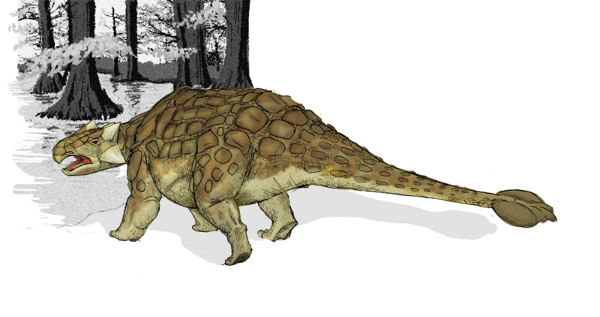
But it’s also a game that’s super-easy to prep for: Og. My prep time consisted of thinking of a vague plot earlier in the afternoon, plus photocopying character sheets. The vague plot I came up with was “a thing like an ankylosaur decides to sit in front of their cave. It’s hungry, and could be friendly, but it also has a big mace-like tail.”

Illustration of an ankylosaurWe did character generation, which took about fifteen minutes (usual for Og — have I mentioned that it’s easy to run?). The players got into the system pretty quickly — they understood how the vocabulary limits are supposed to work and embraced it with gusto.

And then we were playing. They figured out that the big thing blocking the entrance to their cave was a huge ankylosaur-like beastie. (One player later asked me what exactly it was — a mammal, or what? I replied “I have no idea!” And Og works better like that.) There was a great deal of stick-throwing, rock-throwing and near-wordless debate about what to do with the giant beast. It ended with one character riding the creature into some woods and apparently domesticating it.

Overall, it was lots of goofy, silly fun. The players all seemed to have enjoyed themselves. One player said I’d given him new ideas on how to run Og. (Should’ve asked what specifically he was thinking of, but didn’t think to.) Another player — the one who eventually domesticated the beastie — showed me a piece of art she did to illustrate her character’s accomplishment, and said it’d be okay if I posted it here.

Player's illustration of Og game

Wow, Og fan-art!

So overall, a great first session to start the con with, even with me almost running late.

Time Travel, Microscope and Doctor Who

Zooming in on a police boxI was just reading over my notes about time travel and RPGs. I mentioned towards the end that a game where players could go back and change the events that had happened would probably require some sort of publicly-visible chronology, front and center, usable by the players. And the game that comes to mind when I think of this is Microscope.

As I think about this again, it seems like Microscope could very readily do a Doctor Who-style game, with time travel and different incarnations and whatnot.

For example, the palette could easily be used to describe the limits of time travel in this game. Can this Timelord (or this regeneration of this Timelord) fall in love? Is this TARDIS made of dwarfstar metal or wood? Will there be companions who can operate the TARDIS or not? Who will be the big baddies for this timestream? Are they redeemable?

Even more than this, the default Microscope method of play — where different players decide who will take which pivotal role in given events — meshes wonderfully with the Doctor Who system of incarnations. No real need to worry that this particular Timelord is being played inconsistently, because if Angela plays the Timelord during this event as a giving, loving, bashful person, but Brenda plays the Timelord as a harsh, efficient technocrat, it’s easy to explain the difference in styles as the result of a regeneration. And that clearly calls for a scene later on to find out how the regeneration happened!

Further thoughts: rather than voting on whether a given event was Light or Dark, players could decide whether or not a given event was a Fixed Point. Events that are Fixed Points can then be revisited, but not changed.

There would need to be a system for keeping track of paradoxes or changes in the time-stream. Perhaps adding a third dimension? If you stack an event on top of another one, that is then the new way that event played out — and all events deriving from it are then placed in paradox.

Perhaps one night’s session could follow some thematic element, such as The History of the Daleks. Or it could just be one regeneration in the Timelord’s life. Or it could span multiple regenerations. There would be a built-in timer: once your Timelord has achieved 13 regenerations, you know this timestream is complete.

Maybe this is just a passing brainstorm, but the idea seems very workable. I may have to pursue this further.

Apologies again for not posting in such a long time. Life has continued to have me extremely busy, and now Con of the North is a mere week and a half away, and I have a lot of prep to do. Posts may be sparse until after CotN.

Twelve dozens

12 logoIn November of 2012, I made a post about the Traveller supplements 76 Patrons. It inspired me to do a number of posts with twelve variations. I chose twelve rather than, say, six or ten, because a) it pushes me to come up with creative alternatives and b) it works handily with the Variation Die in Blade & Crown.

Since that time, I’ve written twelve such posts. Time for a round-up!

  1. Item: A Reliquary. Strange old bones, holy relics or something else?
  2. Making Sages Work. 12 ways to make sages make sense.
  3. Classification Scheme for Objects Found in Zone 6N. 123 objects to find in the Zone.
  4. Item: An Amphora. Why would someone put runes and a mud stopper on such a mundane vessel?
  5. Places: A Forest Mound. A strange mound deep in the forest.
  6. How to Invoke That Item?. Different ways to make an enchanted item work.
  7. Items: Random Provenance. History makes for interesting tales.
  8. Item: A Castle-tipped Staff. A strange artifact with some interesting possibilities.
  9. Item: A Warhammer. A rare and deadly armament.
  10. Festivals in Gaming. Adventurous possibilities when festival time draws near.
  11. Places: The Sapphire Dome. A beautiful and dangerous place.
  12. Encounters: The Tea-Seller. He brews the best tea around.

And here’s a bonus, which includes twelve different possible denouements:

  1. Adventure Seed: Tenement Defense. How will you defend your home against marauding foes?
Another week without an update! Apologies — life has been extremely hectic lately.

Dollar Store Dungeons, part 5: Chess

Logo for dollar store dungeons, showing a $-shaped dungeon with various beasties and cranniesMy next Dollar Store Dungeons purchase was a pretty easy choice: one of the world’s oldest wargames, chess.
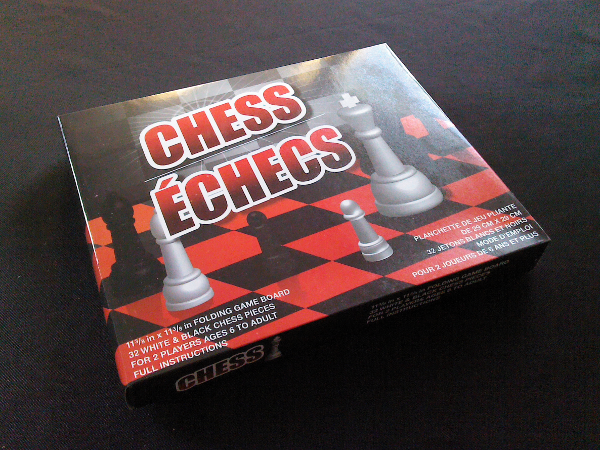
Dollar store box set of ChessNot that I intend to play chess, that is. (If I’m going to go that old-school, my preference is 圍棋 Wéiqí.) Instead, it’s about the cheapest price I’ve ever paid for cheap minis. At 32 minis for $1, that equals about three cents each. While it’s certainly possible to get cheaper ones (the word “free” comes to mind), these are about as cheap as it gets while still spending money.

Chess pieces work admirably as gaming minis, I think. They are both generic and suggestive. They generally suggest standing combatants, unlike, say, coins or paper clips. Yet they’re generic enough that they don’t suggest any particular kind of combatant too strongly; they don’t cause the cognitive dissonance that comes with saying “these orcs here are actually ents, and the humans with black helmets are actually giants”. Also, these chess pieces are a whole lot cheaper than dedicated minis.

Here I should admit that I haven’t actually used chess pieces for gaming minis before. I only use minis about twice a year with either of my gaming groups, and so far, we haven’t needed minis that I didn’t already have. But I know that some day, there will be an encounter with ghouls, elementals or some other creature that my existing minis don’t work for. The chess pieces will then come in quite handy.

Another idea comes to mind: they’d make great mass combat markers for Blade & Crown. The mass combat system requires two colors, with a few different counters each. I’ve usually used glass beads in the past, but I can easily see using chess pieces. Somehow makes sense to use pieces from one of the oldest abstract mass combat games when doing abstract mass combat.

Mysterious creatures

Monsters and eerie creatures in a setting should be mysterious, I think. Not cookie-cutter, copied-from-the-manual things that players already know:

Green hair, orange wings, floating on a glistening bed of slime? Yeah, that’s a Wumpuscule. It has flaming fingernails, is invulnerable to edged weapons, gets a +4 to surprise attacks… I think you’ll find it on page 147 — no, wait, page 142 — of the Creature Catalog.

Nothing drains a game of adventure as fast as knowing exactly what to expect. So how can you preserve mystery surrounding creatures that PCs encounter?

Illustration of strange glowing shapes in the oceanOne method I’ve found that works well is to simply not know where things will go. If you don’t know how a creature works, then the players won’t, either. For example, when a Blade & Crown group encountered some dimly glowing forms in the ocean near their ship, I was thinking vaguely of an etching by M.C. Escher called Dolphins in a Phosphorescent Sea. (Note that my illustration here is not that etching, because Escher’s original appears to be under copyright.) But those strange glowing shapes were really about all I had in mind; no particular abilities, motives or even physical substance. It just seemed like a potentially interesting thing to throw at the players.

Among other things I hadn’t decided beforehand about those strange, glowing shapes was what they’re named. Was it the first time humans in that campaign world had encountered such entities? Probably not. But that’s the thing about myth: information gets twisted, retold and re-spun until what one person calls a “wyrm”, another calls a “dragon” — and another calls a “snake”. So, I reminded myself, there’s no need to have a specific, established name for these creatures.

Upon examination, one character remembered hearing some tales about them. (A fun character: a pedantic scholar, sort of a sage, seeking information about different flora and fauna.) If memory serves, he added a bit about how they’re the spirits of drowned sailors. This gave me some interesting ideas, so I asked the player, John, to name these strange glowing shapes.

This took a fair amount of player trust, of course. He could’ve called them “Nurnie Bloops” or “Glowy Water Thingies” or any other flavor- and immersion-destroying thing. But he’s inventive, and he knew what flavor I was trying for, and he was into it. So he named them “Spirit Dolphins”.

It’s really quite a lovely name, one that encapsulates what the creatures are, while preserving a bit of the mystery surrounding them. I liked it so much, actually, that I included them with that title in the “Fanciful Creatures” section in Blade & Crown, and credited John with naming them. I kept the description intentionally vague, so as not to deprive you of your own interpretation of how spirit dolphins — or whatever your players choose to call them — work.

In fact, I tried pretty hard to preserve some mystery around all the encounters presented in Blade & Crown. If I may quote myself:

It is especially important to point out that many of these creatures are fanciful or downright mythical; their actual characteristics, if encountered, may vary wildly from the prognostications given here.

Another way to keep things mysterious is to have conflicting information available within the setting. In fact, I think that having conflicting information out there is one of the ways to make a setting feel real. Is there an objective truth to be found? Certainly. But what are the chances that everyone in the game world has access to it? Think about modern “mythical beasts”, such as the Higgs boson or giant squid. There is a fair amount of conflicting information out there, and although some people have more objective facts, none of us yet have the whole picture. None of us get to consult the Book of Objective Truth About Everything when we encounter something we haven’t seen before. And so there’s a lot of conflicting information out there — some of it right, some of right but from a different angle, some of it flat-out wrong.

Adventurers, by the same token, shouldn’t already know that Grenge-beasts are immune to silver, or that threlks always lay their eggs in water. If you think about how information flowed in the middle ages (and heck, how information flows now), there are usually competing theories for quite a while, until someone pins it down. Following that model, there are many theories on how exactly spirit dolphins work — but for now, a lot of mystery remains. So perhaps one person says that those glowy shapes are the spirits of dolphins who’ve sacrificed themselves to save humans; but someone else says they’re sirens, trying to lead sailors astray. And others don’t believe they exist at all. Putting out conflicting information in this way has the happy effect of both a) preserving mystery and b) making it feel more like the way the real world works.

Even the name may not be objective. As I mentioned above, one person’s “dragon” may be another’s “snake” and another’s “griffin”. So does everyone in Calteir call those strange glowing marine forms “spirit dolphins”? Almost certainly not. But it’s what the characters call them, and that is (for most purposes) what matters.

Do I, as the GM, know how spirit dolphins work, and what they’re about? Certainly. I have access to the ‘objective’ truth, to the extent that any exists, for my campaign world. And the same goes for lots of other unusual creatures. But because of how we tend to treat rules as written in stone, even when we remind ourselves not to, and because of the way things get reified in RPGs, I find the best way to preserve mystery is to present some things in an ambiguous way.

This can, of course, be frustrating if you need a monster now. GMs don’t always have the ability to create monsters on the fly: maybe the system isn’t flexible enough, or the GM doesn’t have the practice, or just doesn’t have the time. I tried to strike a balance in Blade & Crown, by presenting some systems for unusual effects (incorporeality, swarms, etc.), by giving stats for a good smattering of creatures, and by giving frequent reminders that everything presented is only a serving suggestion, not the way it has to be.

Another prime method of preserving mystery with regard to monsters is simply to keep them rare. This keeps monsters from feeling like extruded random silliness. It keeps them at the edge of the characters’ world, where shadows lurk and unknown elements can stay mysterious. It also helps save you, as GM, time. Not having to come up with a new flock of beasties every week means you can allow those select few to feel more organic and more well-developed. That means that the week’s scenario planning can’t just consist of “roll percentile for which page of the Creature Catalog they’re fighting this time” — but if you’re striving for mystery, that’s probably not a good place to start anyway.

Okay, time to sum up. Here are my favorite methods of keeping creatures mysterious in RPGs:

  1. Don’t predetermine where things will go. If you don’t know, the players won’t, either.
  2. Leave labeling to the players. Adventurers get naming rights.
  3. Present conflicting opinions. Mysterious means no pre-existing objective data.
  4. Keep them rare. Familiarity breeds boredom.

Dollar Store Dungeons, part 4: Die-cast vehicles

Logo for dollar store dungeons, showing a $-shaped dungeon with various beasties and crannies

This is, I think, the Dollar Store Dungeons purchase I’m least certain to use in a game, but so cool I couldn’t pass it up:

Set of four die-cast police vehicles

Four die-cast vehicles: a helicopter, a patrol boat, a van and an APC. Not especially enamored with the “POLICE” written over each one, but the single pieces are pretty cool. It makes me want to play Car Wars again. (Well, almost.) Anyway… the vehicles are not to scale with 25mm figures, but they are to scale with other die-cast vehicles.

The best thing about the whole set is the APC. It has four wheels; they’re a bit undersized compared to the vehicle itself, and the undercarriage totally doesn’t look like an APC’s does. However, the small wheels almost give the APC a sense of floating — it could easily work as a hovertank or starship. In fact, it looks more than a little like Jesse DeGraff’s interpretation of a Traveller SDB. Not only that, but as I discovered after getting it out of the package, the turret rotates!

Police APC toy with turret rotated

I’ve had games where an APC like this would’ve been handy as a mini, even just for giving a general sense of where everything is, even if it’s not to scale with the character minis. And being able to use this as a starship or hovercraft now has me thinking about running a science fiction game, which I haven’t wanted to do in several years. I’ll just need to figure out a way to paint out the huge logo and it should be ready for gaming.

Space Engine

Check out Space Engine. It’s a free (but not open source) program that allows you to fly to and explore a vast array of real and procedurally-generated places in the universe. It’s Windows-native, but seems to run quite happily in an emulator on other OSes. It’s not a game, really; there’s no quest, no goal, no endpoint, save exploring the universe.

Space Engine generates galaxies, globular clusters, nebulae, star systems, planets, moons and a gazillion other things, all pretty much on the fly. It’s easy to take screenshots from within the application, and you’ll want to, because it’s full of jaw-droppingly beautiful vistas. Here are a couple examples, both from putative Earth-like planets within a globular cluster in one of my favorite galaxies:

Example of a world generated in Space Engine

Another screenshot example of a procedurally-generated planet from Space Engine

In addition to gawking at all the beauty, you can export surface maps of planets. For gaming purposes, the applications of this are pretty obvious: you could go find a planet that suits your purposes, export the surface, and you’ve got a near-ready-for-gaming-use worldmap. The planets still tend to have that obviously fractal look to them, and I still prefer maps either drawn by hand or based on real clouds.

But they’re certainly pretty. Being able to fly around them and even down to the surface is also quite a feature. Just watch out for the occasional whole-hemisphere super-storm.

Another screenshot example of a planet from Space Engine

You could also use Space Engine to generate a cluster of worlds for a science fiction game, though it might prove cumbersome to use within a game session. One good use would be just helping you think of original astronomical situations for PCs to encounter. Also, the included 3D star chart viewer isn’t bad; could be handy if you want to know the way from Deneb to Alnitak.