One year!

Birthday cakeIt’s already been a year on this blog! Wow. There have been something like 16,000 visits; 162 comments; untold pieces of spam; and 144 posts. Blade & Crown, and this blog, continue to be rewarding for me. I hope they are for you, too! Here’s looking forward to even more cool stuff in the future (and thank the powers that be for working spam filters)!

And because why not, here’s a gaming idea: do your characters ever celebrate birthdays? Seems like even in games I’ve had where birthdays are generated (HârnMaster, primarily), those birthdays never came up after their initial generation. Of course, that demands the question of how birthdays are celebrated in a given game culture. Do people eat cake? What about longevity noodles? Maybe it’s tradition to capture a bear on your 22nd birthday as a sign of adulthood; maybe a magical effect only takes place when you reach 63. It makes me think of rites of passage and liminal states — all interesting things to include in a game!

Classification scheme for objects found in Zone 6N

Banner image for From The Zones projectMy friend John is doing a cross-blog community project called From the Zones. Folks are describing weird places, things and notions set in the universe(s) of the novel Roadside Picnic and the movie Stalker.

Here’s a contribution from me: a few brief excerpts from an academic paper that belongs to another universe. Summarized below, the classification scheme of Thessolides, Stringer and Settingstone:

In their seminal work, Tarus and Hansdottir (78) designed a classification scheme for objects found in Zone 6N. Although now the standard scheme in our field, their nomenclature has proven at times cumbersome. Our work over the past three years has been to further categorize and systematize the objects. We have devised a further refinement of their classification scheme which instead uses three main categories and twelve sub-categories within each. This, we submit, allows objects to readily be sorted and described, using both standard and non-standard LTN codes.

The coding table for our classification scheme is as follows:

Category T-H Descriptor 1 Our descriptor Form
1 01 Mirrored 14 Mind F Bread
2 23 Disjoint 28 Life N Tendrils
3 72 Tenuous 17 Truth T Foam
4 90 Poisonous 15 Depth X Marker
5 27 Ciliated 50 Allegory Q Syrup
6 43 Reduplicating 51 Numinosity M Projectiles
7 87 Sierpinski 13 Bromine B Sphere
8 91 Toroidal 34 Gravity W Chamber
9 12 External 49 Uncertainty U Sheet
10 51 Intermittent 64 Filth Y Obstruction
11 13 Hungry 70 Fermion M Funnel
12 75 Matryoshka 92 Failure A Dispenser

Examples

It may be helpful to compare the relative nomenclature of several objects, illustrating how their Tarus-Hansdottir nomenclature compares with the present system.

T-H nomenclature: “Object 8177/456-13D-composite-14”
New classification: 7517T Matryoshka Truth Foam
For those unfamiliar, this is the substance discovered by Ericson and Tozinga, in which each nested bubble contains N2+1 universes.

T-H nomenclature: “0937/D14-sub-900F”
New classification: 0114F Mirrored Mind Bread
Again, for readers who may not have read the work of Tozinga and Querus, this is the substance that seems to perfectly mimic within itself the brain patterns of those observing it.

T-H nomenclature: “01911011001178/G139871-T400+D120”
New classification: 1392Q Hungry Failure Syrup
Described by Tozinga and Hallefson as “seemingly desirous of congealing where major personal disaster is about to occur” (214).

Although the TSS classification scheme was sorely received by the academic and stalker communities, it makes a nice addition for gaming purposes, no? Roll D12 three times and see what strange new object the Zone has turned up for you.

“From the Zones” image is courtesy of Hereticwerks.

The night my hall director solved Car Wars

Cover of the plastic box version of Car Wars; illustration by David DietrickRecent discussion of the Tin reminds me of Car Wars. Starting sometime in the late 80s, my interest in Car Wars paralleled my interest in RPGs. For a few years there, I gave both an equal share of my free time.

My strongest association with the Tin and Car Wars is a horrible campaign I tried to run at the Tin which would pit various teams and vehicles against each other. I had really not thought out the GMing logistics or budgets for such a campaign, and it fizzled almost before it started. Also, one player named Bob found ways to manipulate my setup enough to make me really, really dislike rules lawyers for a year or two.

My interest in Car Wars continued, though. I kept buying the supplements, even though I sometimes got annoyed at how poorly playtested some of it seemed. But it was so much fun that I kept up with it. It was tremendous fun designing cars — much like I imagine the fun of building a good CCG deck to be, with the balance of power, flavor and various subsystems. It’s about constantly striving for that perfect design. Car Wars, I realized at some point along the way, really is for min-maxing; Bob, who’d nearly ruined my enjoyment of the game so many years before, was just exploiting the game better than anyone else.

When I got to college, some of my gaming friends were also into Car Wars. We played occasionally; sometimes, if I remember right, Saturday gaming would be Car Wars instead of whichever RPG campaign was otherwise being run. And when I moved into one particular residence hall, I was lucky enough to have a roommate and a hall director who were into Car Wars.

We were all fairly well into the game. I ended up with a pretty large collection: all the Uncle Al’s catalogs, the AADA Vehicle Guides, quite a few issues of the AADA Quarterly, three or four different editions of the rules (gotta have rules for gasoline engines! gotta have rules for blimps! gotta have all the latest errata!) and a huge assortment of counters and maps. I tinkered with starting an actual AADA club and with trying to use Car Wars as an RPG, with continuing campaigns, roleplaying and the whole deal.

I have fond memories of someone suggesting, around midnight, that we play Car Wars. We’d have cars designed by about 2am and usually be done playing by 5am. When we had classes in the morning. Ah, the excesses of youth.

We spent a lot of time trying to tweak and optimize different designs. For quite a few games, I kept trying to make a workable ramming vehicle. Usually pickups with a lot of metal armor on the front. I never managed to pull off an effective ram, but I persisted. I also usually tried to work in a turret, while a friend was always satisfied to just have one or two arcs of fire available. We all had our design predilections. Car Wars is, or at least was, very much a game for design optimization and min-maxing.

One night, we had a pretty high budget ($40,000 or so, I think it was — and remember that’s effectively 1980s dollar-equivalents). I was running around with a ram-based design with, probably, a turreted vulcan MG or laser (low to-hit numbers — another design predilection of mine) and missing a lot, as usual. I think my friend was running something with an anti-tank gun mounted forward (he preferred rarer hits that hit for a lot). And the hall director was running the weirdest design I’d ever seen.

His car just drove around the track, dropping junk as it went. Junk droppers were, at the time, a new addition to Car Wars; they just add a tiny little hazard to the track, one that is pretty easy to avoid driving over. The hall director also kept taking pot-shots at us with some minimal weapon: a vehicle-mounted shotgun or something. Neither the junk dropper nor the shotgun cost much at all. My friend and I were completely puzzled as to why he wasn’t hitting us with anything more powerful. Where had his $40,000 gone? We good-naturedly kidded him for designing a car that was so useless.

Finally, when the cars’ positions were just so, the hall director said,

“Now I trigger the detonator.”

“‘The detonator’?” my friend and I asked, with a mixture of confusion and incredulity. “‘The detonator’ on what?”

“The detonator for the huge mound of plastic explosive that is located in that junk pile,” he said, pointing to the pile that was neatly located a short distance between my friend’s car and mine. Located, of course, on the other side of the board from his car.

We looked up the damage, which was well into “rip up the car counters and drop them from a great height above the table” range. My friend and I stood agape for a few moments.

Then we congratulated him on the perfect design. And we never played Car Wars again.

Item: an amphora

Image of an amphora with script on itThis is an amphora, like many used for shipping food, oil or other commodities. There are only two things that distinguish it from a thousand other amphorae:

  • An ancient, extravagant script and glyph are inscribed on it; and
  • A mud stopper (now dried) has been sloppily applied to its end.

There is no apparent way into the amphora without smashing it or breaking the stopper. It is quite heavy — bulk 9 or so — and when moved, it doesn’t slosh or shift; whatever’s inside it is pretty solid.

Possibilities:

  1. The script on it says Property of Grenthia of Nirman: Precious! This should excite any bibliologist, because Nirman was the location of the Great Library of the Ancients, and Grenthia was its last Chief Librarian. The amphora contains a few dozen scrolls, hastily assembled from the Grand Library of Nirman, shortly before it was destroyed in fire. Some of the scrolls have been considered missing ever since the fire.
  2. Emperor’s use only: Dragon’s Blood! It contains a few handfuls of Dragon’s Blood, which resembles sand but is a dark red color. No one knows if it actually comes from dragons, or is artificial, or where it comes from — in fact, this is likely the only supply of Dragon’s Blood anywhere in the world. When taken as a drug, the substance amplifies the user’s best qualities quite strongly; taking one grain will increase your highest Trait by one point, taking two grains will increase it by two points, etc.

    However, the drug is also incredibly addictive. Every time you take it, you must roll to avoid addiction, with a penalty equal to the number of grains you’ve used. (Thus, once you’ve used more than 10 grains, addiction is almost automatic.) Once you’re addicted, you must continue to take it or lose one point from one characteristic (determine randomly) per day. The drug was once used to help an emperor conquer all the lands around, but the empire fell a short time later, eaten from within by addiction to Dragon’s Blood.

  3. Dragon Eggs: Handle with Care! It contains a few dozen dragon eggs, very tightly packed. In fact, being packed together for so long has caused them to deform so that most are now cubic or similarly angular. Even if the amphora is shattered, they will maintain its shape. They will not hatch unless exposed to extreme cold for a very long time.
  4. Nefarious Genie: Do Not Open! It contains a genie who has been asleep for a thousand years. Opening the amphora isn’t that hard, but waking the genie is nearly impossible; it has already slept through a thousand years of history. Upon waking, it will be distressed to discover that it has been asleep so long. It will be quite destructively angry, unless it can be persuaded to accept the passage of so much time.
  5. For the Negotiations of Keftud: Important! The amphora contains a plethora of maps, all finely documenting and detailing the border between the states of Kefedra and Tudelmo. The maps lay out a highly complex but thorough resolution to the ancient border dispute which has caused dozens of wars over the centuries. These maps may be the ones fabled to have been lost during the 17th Tudulmo-Kefodra War; if so, they would create a strong precedent that the current borders should be (yet again) rearranged, though hopefully this time for good.
  6. Clothing of Emperor Sirtan: Do not wear! It contains a full outfit of clothes, including a fur cloak, in an ancient style. The clothes belonged to Emperor Sirtan, executed hundreds of years ago for crimes against the realm. Wearing the clothes will give the wearer some rather amazing powers (the hat gives the ability to hear courtiers at court, even when not in the Capital; the gloves give immunity to poisons; the ring gives the ability to count money quickly and accurately; etc.). Wearing them for an extended period of time will, however, slowly drive the wearer mad with megalomania. The Emperor was buried in clothes resembling these, but without the magical powers.
  7. For the future: 17th Year of the Green Turtle. It is a time capsule from an ancient era: vessels of food, eating utensils, everyday clothing, a disassembled loom, three candlesticks, a dozen candles, a knife, a sheaf of parchment, etc. All are very well preserved. The parchment include an inventory of the contents, a letter of greeting to the openers, and an uncannily accurate prediction of events from the time of the 17th year to now, and even into the future.
  8. Shards of Enteril: Do Not Reassemble! It contains about a thousand incredibly sharp slices of obsidian, very carefully packed. Unlike other obsidian, they are not prone to chipping, so they can make excellent weapons. The individual chips have an almost magnetic property that causes them to move together over time; and someone who keeps one of the shards will often find reasons to go nearer to the other shards. If reassembled, the pieces form a sphere that will begin to suck everything in the universe into it.
  9. Sleeping Earth Elemental: Do Not Disturb! The mud end is in fact part of the creature. Waking it will cause the elemental to immediately demand payment (in nodes) for not destroying whoever has awoken it.
  10. Ogre’s Draught: Potent! The amphora doesn’t slosh or shift when moved. The inside surface of the amphora is caked with yellowish crystals. If submerged in water for a few days, they will become False Ogre’s Draught, a liquor that (in spite of the name ‘False’) is still incredibly potent; drinking more than a few sips will send most humans into a horrific vision-filled state, and drinking a full tankard of it will bring on a fierce unreasoning rage. False Ogre’s Draught also smells incredibly strong, and will attract any ogres within a dozen miles.
  11. Property of Yuterron: Do Not Open! Yuterron, as any mage knows, was one of the first masters of magic, who became adept in using nodes of every element. This is the famed Amphora of Yuterron, which contains notes and formulae for the most difficult, most high-magnitude spells — but only for one element. And while fire mages say the notes are for fire magic, life mages say the notes are for life magic, and so on. Many even believe that the person opening the amphora will determine just which element it is for, so mages will pay a princely sum for the unopened amphora, while an already-opened amphora is worthless. Opened by anyone but a mage of the highest caliber, it contains nothing but dust.
  12. From Iritea to Solomo: Dowry. The amphora contains a dozen or so sheets of fine silk, serving as packing material for various necklaces, signet rings, small statues (models of various houses and horses), etc. According to certain ancient (but unenforced or forgotten) laws, several of these items entitle the bearer to possession of estates in the realms that once belonged to the Iritea family. One or two items will give religious protections to the descendants of Solomo, if any can be found.

Gaming history: Mention of the Little Tin Soldier in a newspaper article, 1984

With a recent comment on my post about the Little Tin Soldier, I was curious what else I could find about Don Valentine on the net. With the exact search terms “Don Valentine” and “Little Tin Soldier”, Google returns just one hit: a scanned newspaper article from 1984. It’s from the Charleston, SC News and Courier — an odd place for an article mentioning a Minneapolis FLGS. But I note that the article was syndicated by Knight News Service, which apparently at one time owned the St. Paul Pioneer Press. So I’d guess the article was originally published in that local paper, then syndicated on from there.

Here is the main part of the article, with the relevant paragraphs highlighted:

Google scan of article mentioning the Little Tin Soldier

And here’s the relevant text in a more readable form:

The idea of game-playing takes on a slightly different meaning at the Little Tin Soldier, which specializes in war games and fantasy role-playing games like Dungeons and Dragons. The fantasy games generally appeal to a young audience and involve taking an imaginary character through a series of adventures.

Don Valentine of Little Tin Soldier in Minneapolis says there are two major types of war games: the board games, in which players re-fight a historical campaign with all the advantages and weaknesses of the original generals; and “figure gaming”, in which players set up a battlefield on a table-top and use scale-model figures and special rules to fight one another.

Chris Rudolph of Little Tin Soldier’s St. Paul store says it is now possible to re-fight most of the major campaigns of World War II in board games. A Vietnam War game is a big seller these days.

Those paragraphs are interesting for several reasons. First, it mentions the St. Paul branch of the store. I had almost entirely forgotten that the Tin had a St. Paul location until that recent comment. Also, that confirms to me that the story derived from the St. Paul newspaper, as a Minneapolis paper probably wouldn’t bother interviewing someone from the St. Paul branch. And last, it seems to deemphasize RPGs at the expense of board games. Was the RPG boom already over by 1984? Or had it never gotten that big in South Carolina? Or something else?

One more reason RPGs are cool

Sample from What's New: how being a gamer helps someone outsmart a muggerIn case you needed it, here’s yet another reason RPGs are cool. Today at work, I had occasion to help with a large-scale evacuation. People with walkie-talkies anxiously relaying information back and forth, fire trucks and command centers, rapidly evolving situations and faster-evolving rumors — the whole thing. I’m not a trained emergency response person, but I could feel my RPG instincts kicking in: “If this were a scenario I were running, what factors might go wrong? What other factors would complicate them? How could the PCs prevent problems before they occur?” Being able to anticipate problems like that helped me come up with a couple good solutions that quickly got seized on as the right way to run things; and my experience handling emergencies in games allowed me to be more helpful in a real-world emergency.

This kind of situation often makes me think of the Phil Foglio What’s New cartoon that looks at how RPGs make you better able to handle different situations. It could be read as self-congratulatory pap (a gamer version of “fans are slans”), but a lot of it is really true, especially (I think) the part about being able to think quickly in a dangerous situation. No wonder the armed forces, State Department and other organizations run ‘exercises’ that look remarkably like RPGs.

Skyrim and Back Again; or, my theory of modernity and CRPGs

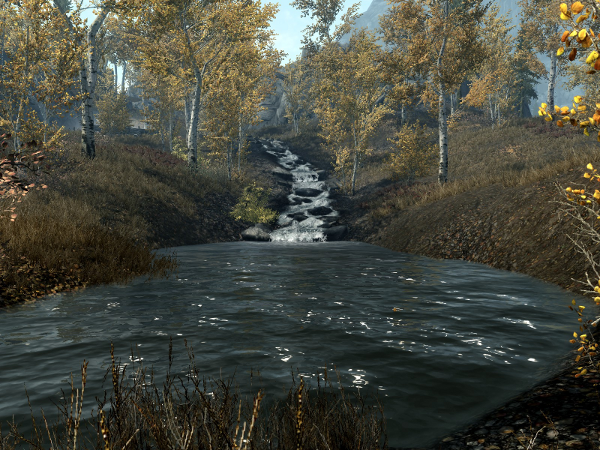
This past weekend, for various reasons, I felt like playing Elder Scrolls V: Skyrim again. After a long time getting it to update, I was back in the Velothi Mountains and soon exploring Tolvald’s Cave. It was just as pretty as I’d remembered it. I mean, how can you not love scenes like these?

Still image of a pond from Skyrim

Outdoor nighttime scene in Skyrim with aurora and houses

Underground scene in Skyrim with Dwarven architecture and my companion, Faendal

The visuals in Skyrim are still quite amazing, even without a lot of mods or add-ons.

And the level design on display is quite good: there are things going on everywhere in the province, and adventure is rarely more than a minute or two of travel away. The creators clearly had a lot of fun; there are interesting little details all over the place, such as strange bouncing orbs of light that make pleasant chiming sounds and occasionally knock over buckets.

Strange little orbs of greenish light in Tolvald's Cave system

What were they doing there? Why do they chime? Why did they disappear the instant I’d defeated a non-corporeal undead beastie? It’s not explained, just a nice little magical mystery. That detail reminds me a little of Miyazaki Hayao’s movies, where there are interesting, surprising worldbuilding choices around every corner, sometimes left unexplained.

And of course it’s fun to see magic effects in real-time, and to level up (Level 48 sneaky archer, thank you), and to look at the map and see all the places I’ve explored, and all.

Yet playing Skyrim again reminds me of how hollow a CRPG can be. The level design is pretty good; there’s rarely a dull moment, and if there is, it’s because you’re looking at the beautiful scenery. But it feels much more like level design than it does like worldbuilding. There are tons of adventurous things to do, all over the place; mysterious ruins, dangerous caves and civilized outposts are cheek-by-jowl, often separated by only a few dozen yards. It’s the old “why is there a 50′ dragon in a 30′ room, with no source of food?” question, writ large, all over the landscape.

Skyrim feels a bit like I’d expect a world built by a large committee to feel: it’s got a gazillion things going on, tons of different narrative moods, and lots of details that don’t particularly hang together. (It contributes to my recent sense that broader narrative input results in gonzo worlds.) For example, did the Dwemer evolve into the Falmer? Did the Falmer kill the Dwemer? Does someone in charge of game development know the answer? I’ve never seen a definite answer to this question, at least. As the Battlestar Galactica reboot showed us, “the writers don’t have a plan” is not a good substitute for true mystery. Skyrim doesn’t end with a whimper; but its version of sandbox exploration — nine million things to do, relatively few of which have any lasting or overarching significance — means that ‘resolution’ is a difficult concept to even apply.

Those problems aren’t particular to CRPGs, I suppose. It’s entirely possible for a tabletop RPG to be composed of a string of combats with nearly no story or worldbuilding to make it all hang together. Heck, I’ve played in games like that. But a tabletop game allows for character actions to be truly meaningful within the world; in Skyrim and other CRPGs, character actions either adhere to a pre-written script (how many Skyrim players have defeated Alduin in exactly the same way, regardless of character style?) or they have no effect on the world at large. Adventure everywhere can too easily mean that adventure anywhere is meaningless.

Skyrim definitely suffers from problems that CRPGs share — problems not shared by tabletop RPGs. Most important, it (like all computer games so far) lacks true AI. That means that, even when the graphic environment appears in glorious pseudo-3D, the interactions with that world feel 2D or even 1D. NPCs only allow about four or five different possible interactions, rather than the infinite potential ways of interacting in traditional RPGs. If you want to interact in a way that the designers didn’t anticipate, too bad. When human-level AI exists, CRPGs may displace tabletop RPGs; until then, though, that lack of human interaction will make CRPGs ring hollow.

Related to this, conflict resolution in Skyrim is far too often via combat. In fact, with Skyrim, it feels quite often like the designers tried to make every single character in the game loathsome, so the player wouldn’t feel too bad about offing them. It’s extremely rare that a random NPC isn’t hostile; the game rewards an “all weapons blazing” approach to almost all encounters. This is grimdark cranked up to universal awfulness, rather than realistic motivations resulting in occasional desperate measures. (Here, Elder Scrolls III: Morrowind was at least a bit better, with occasional peaceful, non-awful NPCs, sometimes even downright sympathetic ones.)

And there are the interaction problems that electronic games can so often have: it’s impossible to climb a cliff (another thing that Morrowind made fun — levitating sneaky archer FTW), and even if you do, your companion will likely get lost along the way; you occasionally find yourself in a part of the dungeon that was poorly quality-controlled, so you have to reset something to get it all de-glitched, and possibly lose a couple hours’ progress along the way; textures look good, but not perfect, and you can instantly tell which barrels are worth looking into and which aren’t. Sometimes your companion fiercely brandishes a handful of nothing in the shape of a spear; sometimes an apple decides to float in midair. Skyrim skews realistic in its overall tone, but the implementation, like for any CRPG, simply can’t approach the realism implicit in direct human exposition.

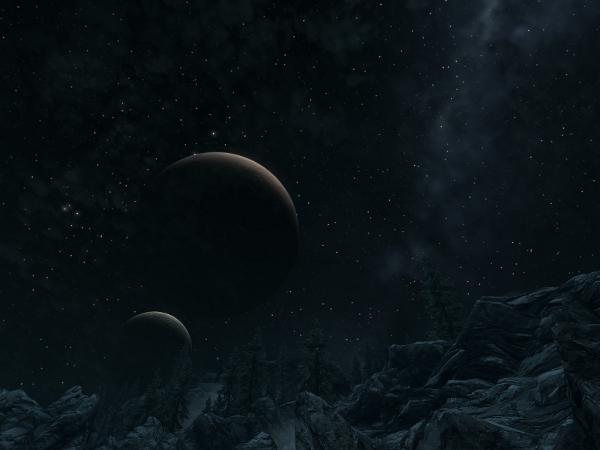
Two moons rising in Skyrim

Yet, for all its flaws, the game still has a lot of appeal. Those visuals really are amazing. I wouldn’t say they’re either more or less immersive than tabletop play, just a different kind of immersion. And (at least when it isn’t taking four hours to update itself) the game allows for a pretty immersive environment. The world of Skyrim is fun, mysterious and adventurous to explore. It requires no scheduling with real-world people, and it gives near-constant random stimulation in a very addictive way. It’s possible to play it for just an hour at a time (though part of your brain is going to be wanting more, very soon). So it and other CRPGs have a lot of advantages over traditional RPGs.

In a lot of ways, Skyrim and other games like it are ideally suited for modern life. For someone constantly ‘on the go’, constantly seeking new information stimuli (‘likes’, politics, gossip, texts, whatever), needing to shift gears every few minutes and have five things going on at once, attuned to a world where tension just continually gets cranked up without ever resolving, full to brimming with anxiety (and constantly finding ways to produce new anxiety), substituting cynicism for true understanding, having no time to devote an entire evening to anything (and certainly not anything contingent on anyone else’s social schedule) — for that kind of person, Skyrim is an ideal game. And, I think, modern life trains us all to be that kind of person.

So part of me loves Skyrim. Part of me finds it a poor substitute for traditional RPGs. Part of me is uncomfortable with the fact that games like this have become so popular. Part of me is glad to live in an age where we have access to such amazing technology. And part of me is hankering to play it again.

Shared narrative control = gonzo?

Last weekend, I was at MethodCon. It was a lot of fun. A highlight for me was getting to do a Let’s Build a World activity again. We devised a world with a square orbit, constant meteor showers, and a single quantum observer who somehow makes it all vaguely hard SF. As always, we ended the activity feeling like this was a world that we somehow knew, one that (in spite of its bizarre mix of elements) somehow all made sense.

Cheese is the medium of exchangeWell after the con had passed, I noticed something interesting. When we started with the atmosphere for this world, the group seemed to want something rather dour and gritty. The descriptors included “comedy of manners”, “polite sniping”, “hard SF”, “alternate Minnesota”, “depressing like Eeyore” and “Cohen Brothers”. Yet in the end, we had a world where “everything is self-repairing except the cheese”, “lead naturally degrades into gold”, weather balloons made from spherical cows are the main form of mass transit and cheese in the medium of exchange. Not exactly dour!

It all leads me to wonder: if there’s shared worldbuilding control, is it possible to have a truly gritty setting? That is, how can a shared world be anything but gonzo?

I’ve seen this before. In Microscope, having the Palette goes a long way toward establishing a common understanding for what sort of mood and flavor the group is going for. Even so, though, I don’t think I’ve ever had a game of Microscope where the mood was established solidly enough to require a particular flavor of game — our Microscope histories always end up with some elements that seem (to me) bizarre and wondrous.

Last Thursday, the weekly group played another game of The Quiet Year. It started off with some interesting possibilities and pretty quickly accumulated very wide-ranging genre tropes: big shark statues, a Deep Dark Cave of Mystery, monsoons, a buried giant robot warrior, a continental split, a strange glowing ship that made people sick, huts made from water buffalo hide, a cry of “Calamari Delende Est!” and other elements. It was a lot of fun, but it would be pretty inaccurate to say that there was a single narrative mood. It ended up being pretty gonzo.

That is pretty clearly a feature for Microscope, not a bug. Opening the gates to other people’s ideas allows for some really fresh and fun worldbuilding to go on. And that’s true for The Quiet Year, and other games with shared narrative control, too.

Yet it still has me wondering: Does the inclusion of multiple voices necessarily introduce gonzo elements? I suppose a big chunk of this is definitional. I define “gonzo” as including a wide-ranging inclusion of genre tropes, without necessarily adhering to one consistent worldbuilding visison, so I suppose that shared worldbuilding control will necessarily introduce a gonzo element. But with a stricter (that is to say, more extreme) definition of “gonzo”, perhaps it’s possible to have enough shared vision to maintain mood and consistency. In normal Microscope, for example, the Palette stops building once someone feels no need to contribute to a round. It might be fun to try Microscope where everyone gets to (or must?) declare a set number of items on the Palette (maybe six?), thereby giving more opportunities for a heavily-defined feel, for example. And I could see introducing a Palette or similar mechanic into The Quiet Year, allowing for a more focused worldbuilding vision.

Maybe it’s definitional in another way: perhaps different people’s senses of what constitutes gritty are just so divergent that it’s impossible to reach a consensus on what exactly that means for game play. I know Eric’s Blade & Crown game is just about as gritty as mine, yet it has a definitely different feel. Not gonzo, but certainly a bit more raucous and wild. Is it possible for two people to have the same definition of “gonzo”? Or of “gritty”?

Finally, to be fair, another descriptor for last week’s Let’s Build a World setting was “wacko”. But maybe that just shows that people like wacko settings.

Places: A forest mound

A forest moundThe adventurers come across an uncanny mound in the forest. It sits next to the barely-worn deer path. Its shape suggests an artificial origin, but it has no stones or other markers nearby. It sits on higher ground, overlooking a swamp or bog below. The bog occasionally bubbles or shivers.

Possibilities:

  1. When viewed from one particular angle, the plants atop the mound appear to form letters of an ancient script. They spell out a warning. If you keep walking away from the mound at that particular angle, you eventually come to another mound.
  2. The mound is one of a series surrounding the large sunken bog. The mounds are spaced irregularly, and are somewhat jagged. If enough people walk around on the bog, it will awaken the sleeping dragon whose teeth form the mounds — and in whose throat the bog is. (And whose occasional hiccups or snores cause the bog to act the way it does.)
  3. The mound is surmounted by a wide variety of mushrooms. In fact, they grow in just the right variety to make Queen’s Draft, an elixir with strange properties. Who cultivated (cultivates?) the mushrooms, and why are the mushrooms still growing this way?
  4. A moss spirit makes it home within the mound, and will be annoyed by anyone walking atop it. However, it may be well disposed to gifts of animal manure, seeds or dead animal bodies.
  5. Masses of sinewy roots can be seen emerging from the base of the mound, beneath the underbrush and detritus; the roots immediately plunge into the nearby ground. When the right beat is played on a drum, the roots will lift the mound up and cause it to shamble in a sloppy, pachyderm-like way.
  6. A wight is imprisoned in the mound. The wight is quite hostile to travelers, but more hostile to the will-o-the-wisps that inhabit the swamp just beyond. Mushrooms near the mound all mark sites where a wisp has fallen in battle with the wight. The spirit of the mound will graciously welcome any help to defeat the swamp spirits.
  7. The mound is almost perfectly hemispherical. If you exert enough energy, you will able to dislodge it and set it rolling downhill into the swamp below. In fact, the mound is just the right size to block up the giant hole in the water near the middle of the swamp downhill.
  8. On nights when the constellation of the Winnowing Girl is overhead, a variety of multihued wisps emerge from the mound. They sing in ethereal tones, using ancient language to sing songs of praise to the constellations.
  9. When just the right words are spoken, the whole mound rises up, turret-like, and is revealed to form the roof of a small stone house. Within dwells the Bog Watcher. She is reticent to say why she watches the bog.
  10. When rain falls, it strangely doesn’t fall directly on the mound; instead, it seems to snake and twist until it falls next to, but never directly on top of, the mound. Yet the plants on the mound grow just as well as any around, perhaps even better. Why did the Spirit of the Mound offend the Spirit of the Rain?
  11. The mound was once the capital of the Empire of Ants, the largest insectile nation this forest has ever seen. They vanished for mysterious reasons several hundred years ago, however. You will need to shrink yourself to ant size if you wish to explore their abandoned metropolis.
  12. When the Kinglion flower ever grows, if it ever grows, this mound is the place it will need to set root. Those who wish the Kinglion to never grow again may wish to destroy the mound.
Inspired rather heavily by a recent visit to the amazing Quaking Bog.