Dollar Store Dungeons, part 3: Glass beads

Logo for dollar store dungeons, showing a $-shaped dungeon with various beasties and crannies

As I alluded in the comments to my last post, this is my third purchase: a very cheap bag of green glass beads. The beads in this particular bag are a good size for gaming, about 20mm in diameter.

A very cheap bag of green glass beads

There are lots of uses for glass beads in gaming, of course. Many games require tokens like these as a way to track fate points, luck points, bennies or something else. They would work pretty well as stance markers in Blade & Crown, too, though you’d need to buy multiple colors for the multiple stances (implying perhaps $6 including tax for a full set). They can work as miniatures when you need quick disposable NPCs. When I run Blade & Crown, I use glass beads to track Traits. Their shiny beauty somehow evokes the ways in which Traits make B&C characters unique. (But hopefully doesn’t make players want to keep the tokens just so they can admire them.)

There are lots of places to buy glass beads like these. They’re available in many gaming stores, for example. Chessex, as a more specific example, sells glass beads in different quantities and packaging that amount to about $0.08-0.09 per bead. Surplus stores sell glass beads more cheaply, perhaps $4.50 per pound. That works out to about $0.05 per bead, with the added bonus that you can mix and match colors. An even cheaper source is the gardening section of the average craft store. (The beads are sold in the planting & gardening section, often as “vase gems”, “container filler”, “glass rocks” or something of that sort. Asking for “beads” will just cause confusion, because that implies pierced beads for jewelry-making.) JoAnn Fabrics, for example, sells a 3lb. bag for $7. That works out to approximately $0.03 per bead. However, these dollar store beads are by far the cheapest of the bunch. There are 72 beads (and one chip) in that bag, which weighs 14oz. That works out to about $0.014 per bead — only about 1¢ each!

The choice of colors isn’t as good as at a surplus store or a craft store, it’s true. And they don’t come with inspiring names like some beads sold specifically for gaming do. But at slightly over 1¢ a piece, they’re pretty irresistible nonetheless.

Dollar Store Dungeons, part 2: Stance markers

Logo for dollar store dungeons, showing a $-shaped dungeon with various beasties and crannies

My second item for Dollar Store Dungeons is something I wish I’d found a few years ago:

Plastic pieces suitable for use as stance markers in Blade & Crown

In Blade & Crown combat, your stance (aggressive, evasive, etc.) is pretty important. But it can be hard for the players to remember what stance they, or someone else, declared at the beginning of the round. When combat gets really tactical and every position and stance counts, it can be helpful to have a visual reminder of everyone’s stances. What I wanted is some kind of counter to show what each combatant’s stance is for the round: a stance marker.

Are stance markers necessary? No, it’s entirely practical to play without them. But they give that added visual element and serve as a helpful reminder.

What should such a counter look like? I gave this some thought, and came up my ideal stance marker:

  • Regular, so that (for example) all Aggressive counters look like all other Aggressive counters.
  • Big enough to be a visual reminder.
  • Not so big that it can’t be placed on the map, perhaps next to a mini or under a mini.
  • Colorful and perhaps varied by shape, making all the different stances obviously distinct.
  • Cheap enough that I can easily afford markers for all the combatants in a melee, even a big one.
  • It should also have the various combat effects of the stance listed on it, so players can remember them at a glance.

I hunted around for different things that would do the trick. Litko makes lots of different plastic tokens for gaming (and by “lots” I mean “really, seriously, a vast array”). They even make customizable counters. But the font size is apparently fixed, so getting enough useful text onto a B&C stance marker would be impossible. Also, the price ($6.99 per set, which implies about $40 for an entire set of stance markers) is prohibitive for my purposes.

I toyed with using colored paperclips (cheap, but not really big or visually obvious enough), Lego bricks (too expensive to get a large enough group, not really in the colors I wanted), hand-colored wooden discs (too much trouble and hard to make them look regular enough for my tastes), or poker chips (also too much trouble, and not visually distinct enough). None seemed workable.

Later, I found some fish tank beads that have done the trick. They’re fairly cheap and come in a variety of colors. They aren’t quite big enough to serve as off-the-map reminders, but on the map they work pretty well. It’s been hard to find them online, but Amazon sells some, albeit not in the variety of colors I found. I think I ended up paying about $15 to get enough to play with. These fish tank beads have served as my main stance markers for a couple years now. I don’t use them every combat, but when I do, they’re very handy.

All of which brings me to the “linking shapes” I found in the dollar store. How do they match up with my standards?

Illustration of stance markers in use, next to or under Lego minifig

Watch out, it looks like the mercenary sergeant is going Aggressive!

  • They’re fairly regular, though different sets have different shapes.
  • They’re definitely big enough to be a visual reminder.
  • Seems like they’re small enough to also fit well on a combat map.
  • They’re very colorful and are varied by shape.
  • They’re really cheap! $1 is easily enough for an entire combat; $2 should be enough for even the largest brawl. These are by far the cheapest good stance markers I’ve found.

The one thing they don’t have is a place to write combat effects, but that’s okay — they’re still about the best markers I’ve found so far. And did I mention they’re cheap? (Cheap enough that I actually bought two sets, to get a better variety of shapes.)

Now, to decide if I should put them under minis or next to them…

Dollar Store Dungeons, part 1: Dinosaurs!

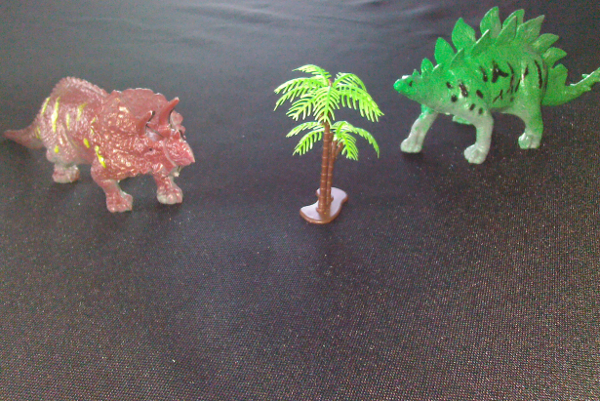
Logo for dollar store dungeons, showing a $-shaped dungeon with various beasties and cranniesJohn and I went out to do our Dollar Store Dungeon run recently and came back with some great finds. Here’s my first item:

Photo of dollar store dinosaurs and tree

It may not be the largest assortment of dinosaurs (there were bags that had more dinosaurs in them), but what I got is pretty cool! A triceratops, a stegosaurus, and a pretty nice palm tree. For $1? I’ll take it!

The palm tree came with an extra frond, which I stuck to the top of the main trunk. Not totally realistic, but it seemed like the best place for it. I almost stabbed myself in the thumb pushing the frond onto the trunk — watch out! Palm trees can be sharp.

It looks like the dinosaurs are about to scale with 25mm figures and Lego minis, too! (As a silly aside, did you know that the spikes on the end of a stegosaur’s tail are actually called the thagomizer now?)

This find now has me raring to include these props in a game of Og. I may have to work them into my Con of the North game. And figure out how to make miniatures useful in Og. (And yes, Og is the kind of game where dinosaurs and early hominids can appear in the same game.)

Want to join Dollar Store Dungeons? See the project page and go find some treasures!

Dollar Store Dungeons: The Project

Logo for dollar store dungeons, showing a $-shaped dungeon with various beasties and crannies

What treasures can you find for $10?

This is the start of a new project, modeled on John Till’s From the Zones project, open to everyone.

How do you participate? Go to a dollar store, buy 10 items, and post about how you’re going to use them in gaming. Easy!

More complete rules, if you prefer:

  • Go to a dollar store and buy 10 items, costing US$10 total.
  • They must be items that you actually want to use in a game, not just items you can vaguely imagine someone using.
  • Post on your blog, or Google Docs, or wherever you like, and describe what you’ve found. You can put all your finds in one post, or spread them out over multiple posts.
  • Comment here or email me to let me know what you’ve posted. I’ll try to keep a running list of what everyone has found.
  • Feel free to use the logo above with your post. Please credit me (Rachel Kronick) and include a link back to this post. The logo is published under a Creative Commons Attribution-NonCommercial-ShareAlike License.

Treasure Table 1:

  • Dinosaurs! here on NJW Games. Two nifty dinosaurs and a very nice tree.
  • There’s A Centipede On My Dollar Store! John’s overview of the project and a tantalizing sample of what he found.
  • Creatures at the Everwayan. Creepy crawlies of many sorts. (And he’s already used them in a game!)
  • Lamprey Centipede at Fate SF. A very cool (and also icky) idea for one particular dollar store purchase, with full Fate stats.
  • Serpent-Tapirs at the Everwayan. Some amazingly inspired worldbuilding!
  • Stance Markers here on NJW Games. A nifty combat accessory for Blade & Crown.
  • Glass Beads here at NJW Games. What’s the cheapest way to get glass tokens for gaming?
  • Other Doctors at Fate SF. A brilliant Star Trek/Doctor Who crossover involving an SR-71.
  • Die-cast vehicles here on NJW Games. A few very nifty minis, suitable for Car Wars or Traveller.
  • Doctor Dolittle at Fate SF. Fantastic ideas for a veterinary campaign!
  • Two Million Swallow Gale at Fate SF. A nifty elaboration on the Doctor Dolittle setting, with a wonderful spell powered by birds. I could see this spell coming in handy for a game set in mythic China, too.
  • More Dollar Store Treasures at They Might Be Gazebos. Some nifty props for minis, some cool coins and an amazing beetle mini.
  • Chess here on NJW Games. The classic wargame, usable as combat minis.
  • False Beholder at Fate SF. Gregarious monocular mercenaries.
  • Paint, brushes and dominoes here on NJW Games. Nice instant terrain for use with miniatures.
  • Pencils here on NJW Games. Writing utensils always seem to be in short supply at gaming.
  • Dry-erase board here on NJW Games. Handy for turn tracking, simple maps or refrigerator moments.

British Library public domain art

Screenshot of the British Library page on FlickrThe art for my last post comes from the British Library. They recently posted more than a million public domain images on Flickr. Most of the images are from the 18th or 19th centuries, so they’re not the best source of (for example) accurate medieval images, but they’re quite handy for many purposes. Check ’em out!

Item: a reliquary

A reliquary.This reliquary is quite heavy and of fairly large size (about Bulk 9), made from a very light-colored but dense material — perhaps ivory or an unusual wood. It is covered with reliefs of major Avatars and exquisite scrollwork. Several of the designs have tiny rubies or amethysts worked into them. Many of the Avatars’ eyes are tiny emeralds, though about half have fallen out.

Possibilities:

  1. Inside the reliquary is the jewel-encrusted, gold-leafed tibia of the Avatar Ferkios, which has been missing for many centuries. It lies on a bed of surprisingly clean velvet.
  2. The interior of the reliquary is sectioned up; each of the four sections contains the remains of a different Avatar.
  3. The reliquary’s decorations indicate, to someone knowledgeable in religious symbology, that it should contain the remains of Selimo the Just. Strangely, though, it contains the bones of an entirely different Avatar, but there is no indication as to why.
  4. The reliquary was sealed more than a century ago. It is impossible to open save through divine intervention. It contains the remains of a necromancer/anti-Avatar who threatened the very existence of the Temple. The reliquary may seem a strange vessel in which to contain such abhorrent remains; they chose it because it was the holiest vessel available. It is possible that removing the remains would cause the necromancer to come back to (un)life.
  5. The interior is utterly clean and dustless, despite having sat in an underground location for decades. The molded shape seems designed to hold a skull, but there is no skull present. There is also a note indicating that the skull was traded to another Temple in exchange for undisclosed favors.
  6. The reliquary contains only a few cobwebs. However, pressing the right combination of gemstones causes several of the reliefs to detach from the reliquary. Beneath each relief is a finger bone, in itself a relic; and put together, they form the full Hand of Iridescent Deliverance.
  7. The reliquary was remade from an earlier reliquary. Whatever relic is contained within ends up acquiring some aspects of the previous relic held within. Why did they decide to remake the earlier reliquary? And who were they?
  8. The reliquary has traveled a vast distance to get here. Several of the gemstones worked into it have been replaced by gems from different places around the world. Its religion is no longer practiced in the land it came from.
  9. The reliquary is the last extant creation of the great artisan Linela of the Ivory Hand. The reliquary was designed by her as the final resting place for her own remains.
  10. The interior contains a moderately important Avatar’s remains. However, the reliquary also has a false bottom; within the false bottom is one of the most important relics in existence, long considered destroyed in the War of 654.
  11. The reliquary is a fake, made to deceive a wealthy merchant, about 100 years ago. It was sold for a heavenly sum. However, the merchant saw through the fake and eventually tracked down the fakers; their remains are contained within.
  12. The reliquary is an unholy fake. It is carefully modeled on another reliquary, but someone skilled in religious iconography will recognize that the Avatars have been subtly altered from their correct expressions. The reliquary will channel and focus evil religious energies; it will eventually destroy any relics placed within it. Indeed, it contains a grey ash that was once the eye of Gethne the Far-Seeing.

Commitments

A hallmark of modern life is we are all being pulled in different directions at once. We have a constantly increasing number of things competing for our time and brain-space: work (and off-hours work, and looking for work, and overtime, and on-call work, and and and…), managing our households, trying to keep up on world events, reading, friendships, family, social media and an ever-growing list of others. For many of us, I fear, gaming comes near the end of the list. When so many other things compete for our time, and when there are pretty stopgaps that almost hit the same sweet spot, it can be difficult to maintain commitments to RPG gaming.

And yet maintaining that commitment is something I try to do. I’ve said before how special I think RPGs are; they are a unique artform, and a unique entertainment. And RPGs require a lot more commitment than some hobbies to work. Astronomy can work on any given night with favorable weather; if not everyone shows up for your Mythbusters premiere party, the event can still go on; boardgames don’t require a particular group of players to be present. Even MMORPG raids seem, in my experience, to be more flexible than most tabletop RPG sessions.

Increasingly, we’re seeing RPGs designed for less of a time commitment. I think that’s a good thing; it is simply a fact that a lot of us can’t commit as much time anymore to RPGs.

However, I also think we shouldn’t lose sight of the importance of commitment to playing groups. We need, at times, to resist societal pressure to be torn in a million directions; we need to be willing to commit to some things. We gamers, with our leisurely, ‘silly’ pastime, get a tremendous amount of social pressure to do things that are somehow ‘productive’. That’s a bad trend — bad because it eventually leads to all of us being ground to dust under the wheel of productivity, and (in the nearer term) because it deprives us of the opportunity to play these amazingly fun games.

Photo of a blacksmith's forgeKeeping a commitment can be hard; making rules for oneself can help make it easier, or at least clearer. In my various groups, we’ve forged a few common agreements that seem to have worked well over the years. I thought it might be useful to list some of these rules that that I’ve found to work. These aren’t necessarily all explicit rules, but we’re working on that (and more on this topic later).

First, I’ll give some of the rules for my monthly group:

  • Unless we say otherwise, we will be there.

    This is, I think, extremely important — maybe the single most important rule. If it’s unclear whether or not others will be there, it causes you to start performing mental arithmetic: do I go and risk wasting my time, or do I stay home and just work on my taxes? It’s all too easy for this to turn into “Well, probably no one else is going to be there, so I might as well not go myself”. Once people start thinking that way, the group is (I think) pretty close to doomed. Especially once people start assuming that others won’t be there unless they say so, it encourages everyone to CYA by not even showing up. It’s a vicious circle that can quickly corrode a group to nothing.

    I’ve been in groups where this is basically what happened. With one group, I had to drive more than an hour one way to get to the session; after a couple instances of a session that barely happened because not-quite-too-many people canceled, I started weighing my onerous drive against the small amount of enjoyment I was getting from the group. And the group as a whole folded not soon after; other people were performing the same arithmetic.

    If, instead, you know with a high degree of certainty that your fellow players will be there, on time, ready and raring to go, it creates a positive feedback loop. It increases your own determination to show up and have fun. Guaranteeing that you are ready and present for the session, and assuming that everyone else will be there: that is, I think, the essence of commitment.

  • Cancellations need to happen at least 24 hours in advance, barring actual emergencies.

    If someone cancels with only (say) six hours’ notice, it messes with the heads of those of us who’re committed to being there tonight, and likely throws a monkey wrench into our schedules with not enough time to address it. Not all of us have access to email (or text, or {insert communication method here}) 24 hours a day, so cancellations need to happen with enough advance notice for us to all respond appropriately. If not, we should all be able to assume that you will be there.

  • If one person cancels, we will continue. If two or more people cancel, we will cancel the whole session and reschedule.

    It’s possible to keep continuity if a small number of players are missing, but if it gets to be too large a number, the game ends up losing a lot. I like to make the specific numbers explicit so that everyone knows what to expect, and so that if (for example) two people need to cancel, we all understand in advance what the consequences will be.

  • We try our utmost to schedule the next session while we’re all in the room for this session.

    Online communication makes it possible for people to respond in their own time; but by the same coin, it means that someone might not respond clearly, or until it’s too late. We’ve all had the experience of trying to wrangle a scheduling discussion via email, and realized how unreliable and ultimately fruitless it can be.

  • We have standard start and end times, and a standard day of the month to meet on.

    We adhere to this standard probably about half the time — a pretty good record, I think. This allows us to build gaming into our daily routines and habits, which increases the chance that we’ll remember it, and the possibility that any given session will happen. At the same time, we also recognize that the standard is flexible. Better that the timing should flex, than break.

  • We always play the same game.

    We know what dice to bring, what character sheet to bring, what records to keep track of, what’s generally going on. Partially because the GM (I) have a lot of stuff to track for the game, I ask the players to remember their own character sheets. Of course, that doesn’t mean everyone always has everything — seems like someone always forgets something. But the basic expectations are clear and mostly adhered to.

Rules for my weekly group are basically the same, with a few key differences:

  • We try hard to schedule not just when we’re playing next, but what we’re playing next, while we’re all in the room together.

    A lot of us have cool new games we’d like to run, or to try. We therefore tend to play a lot of different games, and we have a lot of different games on the back burner, meaning that it’s not always clear what exactly we’re going to play the next time we meet. We realize that it’s important for the GM to know in advance what they’re running, and we now have a fairly good stable of one-shot-ready games for when no one feels prepared enough to run anything.

  • GMs keep track of character sheets.

    With the number of games we play, it becomes more practical for the GMs to keep character sheets rather than players. Players might not bring the right sheets, since the chances that the plan might change at the last minute are non-zero. Keeping sheets with games also gives us more flexibility, meaning we can play whatever game we have materials at hand for.

For the most part, the rules work pretty well. With both groups, there have been clarifications in recent years about the whole ‘coming unless we say we’re not’ thing. And other rules have evolved — usually when small crises required it. But what we have now seems to work pretty well.

Being in Minnesota, it’s occasionally been difficult to get these rules to be explicit rather than implicit. Rules that everyone only seems to agree on are not actually very useful; it’s all too easy for misunderstandings to crop up when we are in a “But I thought you meant next Saturday!” mode. And if no one is willing to state objections to de facto rules openly, the social contract can easily start to fall apart. Yet getting past that Minnesota indirectness can be a tooth-gritting experience. It’s taken a lot of intentional work to get the rules as explicit as they are.

But the work that we’ve done has, I think, served us well. I have two different groups that have been meeting for more than five years, which is (knock on wood) quite an accomplishment in gaming circles, especially these days. It’s not an easy feat; it requires purpose of mind, direct but polite communication, and above all commitment.

Apologies and clouds 2

Photo of a cloud, well suited for use as a mapIt’s been another extremely busy week or so; no time to write anything good recently. So instead, please accept four more photos of clouds as an apology. They are eminently well qualified to be turned into maps. As before, I’m releasing these images into the public domain, but I’d love to hear how you use them!

Con of the North 2014: Looking ahead

A compass roseThis week, the program book for Con of the North 2014 arrived. It’s big! It feels like there are a lot more games than in recent years. There are tons of RPGs, boardgames and other things on offer, including many nifty indie RPGs; there’s a pretty strong track of Tekumel games; and it looks like Artemis Starship Bridge Simulator will be running almost the entire weekend. Lots of great games, which means lots of hard choices!

I’m running three games:

Og Fun! You Play Og.

Og is a hilarious game in which vocabulary is precious and life is silly: You cave person. Big hungry smell thing want eat you. What you do? Friday 6-8pm

This should be a nice goofy diversion. Who knows what adventures will unfold: trying to obtain honey, trying not to get lost in a blizzard, or maybe just hunting mastodons without getting stomped?

The Mountain Monastery Mystery

Religious worthies of the Sisters of Faenwitha have gathered from all over Morensia to discuss a weighty matter: whom the Temples will support in the looming war. But now someone has started trying to win the argument through murder. Can you solve the mystery before the peaceful meeting erupts in a blaze? Maturity regarding LGBT themes required; Saturday 2-6pm.

Lots of inspiration here The Name of the Rose, as I mentioned before.

Microscope

Come create a world with us! We will start with the kernel of an idea, then build a vast, wondrous chronology around it. From broad periods to decisive scenes, we’ll weave a tapestry of fascinating events. Play Microscope and make history! Sunday 2-6pm.

Always fun; can be hard to get the right mood with a group, so I may find ways to increase the palette size.

I’d love to see you there, and to have you in one of my games! Now please excuse me while I go bury my nose in the program book…

Making sages work

I love the idea of sages in a fantasy RPG. That scholar in their study with vast piles of paper, strange artifacts lying around, books half-forgotten, manuscripts half-written, quill pens and half-dried inkwells, perhaps the scholar themselves hard to find in all the clutter… The image evokes mysterious, fascinating knowledge, and the pursuit of knowledge for its own sake — two concepts dear to my heart.

The problem is, I can never seem to make that sort of person fit within a medieval milieu. Is it really possible to make a living as a sage? Seems like consulting for the occasional adventuring party who swings past is unlikely to produce a reliable income. Or maybe the sage themself is a retired adventurer with money and lore money squirreled away somewhere? But then, rumors will spread and next thing you know, they’ve been robbed. Or if they’re a powerful mage, then rumors still spread and they wake up surrounded by angry people with pitchforks. So how can this kind of person actually work in a medieval setting? Here are a few ideas:

  1. Temple librarian: Many religious centers end up becoming repositories of knowledge; there are real-world examples of this. And there will often be archivists in charge of keeping track of it all. These people will accumulate knowledge almost automatically. They may be under pressure to conform to religious dictates, though, and sometimes end up doing tricky theological gymnastics to excuse the preservation of heterodox texts.
  2. Court vizier: An educated ruler, or one who just understands the value of knowledge, may deliberately curate knowledge. And they may find a specialist to keep their collection of that knowledge. Such a person will have protection from anti-intellectuals, but that protection is highly dependent on the status and whims of the ruler.
  3. Cellarer: Someone has to keep track of how many eggs, pounds of flour, spoons, nails, bundles of wool and candles the castle has. Perhaps, in all the clutter (perfectly organized in their own mind, of course), they might have some important reference documents from the past or present.
  4. Merchant with other hobbies: Many kinds of merchants — general outfitters, innkeepers, clothiers, jewelers, shipwrights, engineers — would have reason to accumulate lore about their favored subject areas. Not all are likely to be literate, but the most successful ones might be. And it’s not hard to pass off a manuscript about esoteric knowledge as part of your library of architectural knowledge.
  5. Librarian of a trade post: People in isolated outposts of civilization are likely to want to preserve that civilization’s knowledge. Put that outpost somewhere on a major trade route, and the wisdom accumulated is likely to be a world-class trove. And such a place may well have someone in charge of keeping manuscripts and other knowledge organized; they are likely to speak many languages, and maybe read many more, both current and ancient. Getting to the trade post is sure to be a challenge.
  6. Traveling peddler: An itinerant merchant could easily get away with carrying a strange mix of texts and other knick-knacks. That implies they only have as much material as they can carry, but it’s easy to fit a lot of knowledge into a few sheafs of pages — and easier still if combined with a sharp mind.
  7. Sage as punishment: In a particularly anti-intellectual culture, someone might get saddled with the job of keeping the dangerous sources of knowledge isolated from the populace. This person might easily find themselves reading tomes of forbidden knowledge, having to (like the religious scholar) advocate the safety of the texts while at the same time publicly scorning them: “If we do not preserve the books of the Priests of Siros, how will we combat their pernicious arguments when they rear up again?”
  8. Book seller with a private collection: A merchant may buy and sell books. But in a pre-printing press society, it seems unlikely that anyone would be able to either a) amass a very large personal collection or b) afford keeping books that are not for sale. But perhaps in a large, thriving city.
  9. Leader of a religious minority: Someone tasked with leading or preserving the heritage of a minority group will often, of necessity, become a curator of its important knowledge. Perhaps they are the only one around who can read the Sacred Texts; perhaps they are the only one who can explain what the different beads on the Prayer Cycle mean.
  10. Lexicographer/scribe/lawyer: If laws are complex and few people are literate, larger towns will start to have specialists whose job is to write up contracts, explain obligations, read letters and explain where to sign your X. These folks could easily end up accumulating large piles of valuable papers: old contracts that are still in effect but not currently enforced; historical documentation of border disputes; litanies of historical complaint against this or that merchant house.
  11. Collegian: In prosperous cities, there may be actual colleges. They often begin as loose-knit associations of scholars, trying to pool resources and students. It takes quite a flourishing economy to support such a group.
  12. Village healer: A small village or town will often have a person who knows Herblore, serving as the closest equivalent to a physician. This person will frequently accumulate other forms of knowledge as well. However, this position is always fraught: too little healing and the populace considers you a fraud; too much effectiveness, or effectiveness for the wrong person, and you may be considered a witch or worse.
Apologies for taking so long since the last post… it’s been a busy week.