Dollar Store Dungeons, parts 6, 7 and 8: Paint, brushes and dominoes

Logo for dollar store dungeons, showing a $-shaped dungeon with various beasties and crannies

My next post for the Dollar Store Dungeons project is a three-for-one. Three items that, once I saw them, I knew I’d need to use together.

Item #6: Paint

Photo of dollar store paint pack

The first part of this mini-project is paint. For $1, I wasn’t expecting very high quality stuff. That’s about what I got: just six pots, with not much range of color. The package gives no further information about the paint than just saying “Paint”, but it seems to be acrylic. Seems, because it turns out that several of the pots were completely dried up, forming a gooey plastic-y substance. And they seem to be water-soluble. I’ve left a small amount of water in the pots. Hopefully, they’ll transmogrify from rubbery goo back into paint overnight. (Update, a day later: the red seems to be slowly remembering that it was once paint, but the yellow is still a piece of rubbery plastic. Hopefully more soaking will help.)

The paint came with a very cheap but serviceable brush. And the black paint seemed to work pretty well as dab-able goo. Also, the paint doesn’t seem the slightest bit stinky.

If I had a spare lifetime or two, one of the hobbies I’d get (back) into is painting miniatures. One great advantage of my Lego minifigs is that they’re almost instantly ready for play — no painting required. But still, it’s nice to be able to paint minis exactly as you want them. And to put in the time and effort creating a work of customized art. Sometimes I like to check out Carmen’s Fun Painty Time or Cool Mini or Not or other cool miniatures galleries. And then I realize that I will never have time to be that good, or even really to get into minis, and I go do something else. As I said, a hobby I wish I had the time for.

Item #7: Brushes

The next part of this mini-project: a basic selection of five brushes, with very low-quality bristles. But still, they work well enough for dabbing on gooey paint, which is all I need them for.

Photo of dollar store brushes

What do I intend to use these paints and brushes for? Well, probably not for painting minis, at least not anytime soon. I actually have a large box of 11th-century Normans that I inherited, and I do dream of painting those up someday. These paints are not right for that job, however; there’s nothing metallic in the lot, and I get the impression that trying to mix a decent variety of colors would be far more trouble than it’s worth. I suppose I could use these paints for touching up (or perhaps roughing up) some of my Lego minifigs, but that seems mostly unnecessary.

So what plans do I have for these paints?

Item #8: Dominoes

The last item in the mini-project. These were a great find, and are what inspired me to buy the paints and brushes. How, you may ask, can I use dominoes in gaming?

Simple:

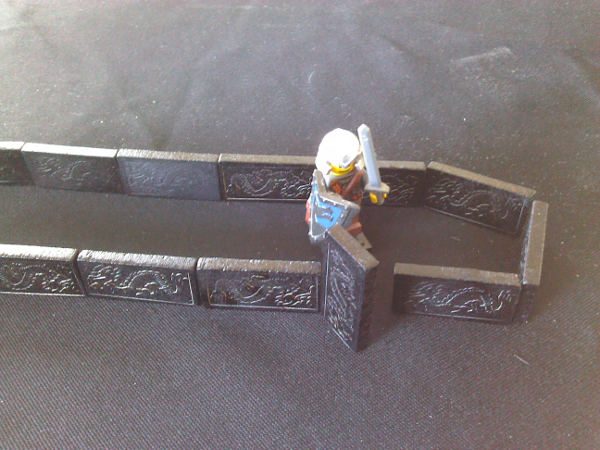
Dominoes serving as dungeon walls -- what's beyond that door?

Dominoes make great props for minis.

They can make great stand-ins for dungeons walls, walls of an inn… even a table or tree in a pinch. Pile them up and they make a cairn or dais. Pile up enough and they can even serve as altitude markers for an aerial combat. They’re generic enough to serve as lots of different things. They give enough dimension to suggest verticality — which lines on a battlemat don’t — but they are also vastly cheaper than the cheapest purpose-made gaming terrain.

Dominoes really have only three problems, as I see it:

  1. Standing up, in portrait orientation, they aren’t really stable enough to serve on a miniatures combat map without annoyingly falling down a lot. (The domino effect is named that for a reason.)
  2. The color isn’t all that suggestive of stone or wood, unless you get more expensive dominoes.
  3. The spots really ruin the sense of immersion (unless you’re trying to simulate the walls of the Tardis).

The first problem is easily taken care of: just set them up in landscape orientation instead. This doesn’t suggest full-height walls, of course, but it has the additional benefit of allowing easier access to the minis. And now the occasional doors look more like doors.

Dominoes serving as dungeon walls in landscape orientation

As for the second and third problems… well, you’re probably starting to see where I’m going with all the paint supplies, right? Dominoes + paint + brushes = nice, blank, black tiles. Ready to be used as castle palisades, a sarcophagus, gates to the Imperial City or a raft for going down the river.

As with some of the other items in this project, I kinda cheated and bought two sets of dominoes instead of just one. A whole $2! For which I got 56 dominoes, and two nice wooden storage boxes to put them in. If it turns out that I can’t make a serviceable brown or grey from the paints, I may have to splurge on some better paints to create wood or stone effects. Hm, perhaps I should go back to the dollar store and look for some cheap spray paint!

Road of Kings: a nifty app

A screen capture from Road of Kings, hopefully legal to place here under Fair Use review purposesThrough a thread on Story Games, I found out about a nifty game app available for iOS or Android: Road of Kings.

It’s a sort of hexcrawl, where you’re out to prove your worth as a barbarian chief by accumulating 500 gold in 100 days. Doing so will mean exploring ruins, fighting bandits and other heroic escapades. It will also mean trying to manage followers, choosing when to have an army in train (and keep them fed and healthy), or when to go it alone. The setting is fairly generic fantasy, with serpent cults, evil castle lords, scary ruins, mercenary sellswords, lurking giant spiders and the like.

An aside: Barbarian Prince was designed by Arnold Hendrick. He also designed Darklands — easily the best CRPG ever — and had a hand in designing Swordbearer, one of my favorite RPGs ever. Hendrick deservedly gets a shout-out in the credits of Road of Kings.

Road of Kings seems heavily inspired by the Dwarfstar microgame Barbarian Prince. (And in case you didn’t know, those Dwarfstar links are to a site where you can download the files for the games, completely legally, to print and play yourself. Check ’em out!) It also bears more than a passing resemblance to the Middle Earth Quest books, at least the hex-based ones like Night of the Nazgûl and Rescue in Mirkwood.

Road of Kings is a great little game. A full playthrough can take a few minutes, perhaps 15. There’s a good variety of things to do, so even though it’s all pre-programmed (as all CRPGs must be), it doesn’t feel too repetitious.

There are some problems: the game has crashed on me a couple different ways now; scores don’t seem to consistently propagate from session to session; many of the special attacks don’t seem to work; and unlocked starting cities also don’t persist from session to session. Once you’ve KO’ed your enemies in a fight, it’s impossible to end the fight without killing them. It might be nice to have a randomly generated map to add replayability. Also, it would be very nice if there was a choice of gender for the main character.

Still, it’s a lot of fun! It’s very engrossing — playing one game (which took about five minutes) made me want to play several more, and the stories are very flavorful. A great casual fantasy CRPG, and totally worth the $0.99.

Con of the North 2014, part 8: Reflections

A compass roseAs always, Con of the North is one of the best weekends of gaming for me. I don’t know how many people attend it, though I suspect the number is in the 500-1000 range. There are bigger cons in the Twin Cities — good gosh are there. But none of the other cons has so much great gaming, all in one place.

Con of the North was at a new hotel this year. It’s west of me rather than east, which I thought would make the commute shorter, but it ended up taking about the same amount of time. Parking was a mixed bag, as I nearly ended up late for my first Friday game. But after that anxiety-creating first experience, I had a relatively easy time finding parking the next two days; and John informed me that there were whole lots of parking that I hadn’t discovered yet.

The hotel seemed at times to exist in six or seven dimensions, with confusing corridors that met in non-euclidean ways and ceilings designed to hypnotize. But again, a lot of this is probably just disorientation from being there for the first time. And the hotel’s concession food seemed to be more reasonably priced than the last hotel’s.

I ended up not staying for as much gaming as last year — ‘only’ seven games, and no boardgames at all, versus last year’s seven-ish RPGs and two non-RPGs. That was due to an incipient cold, and to choosing to catch up socially with Chad rather than participating in Bob’s game. But the games I got to be in were overall great.

Now to start thinking of games for next year…

Con of the North 2014, part 7: Fate of Ringworld

Sunday’s last game was John’s Fate of Ringworld. There was a pretty brief introduction to the setting — not much needed, because we were all at least mostly familiar with Niven’s Ringworld — then character generation. John had added two intelligent species to the base setting: one a heavily augmented species who is able and willing to clone itself; and one a hive mind, Shoggoth-like species. Both were interesting, authentically alien and added to the feeling of realism, I think. (It seems to me that there’s a slight tendency in Niven’s worldbuilding towards stereotype.) I ended up playing a character from that clone-using species; her Trouble was “Life is more fun with no backup”.

We had a long approach to the Ringworld in our General Products spherical-hull starship. There was a lot of discussion of how to deal with the Ringworld’s defenses, which seemed to be tracking us, and of another high energy-signature ship that seemed to be a) friendly with the locals and b) hostile to us. We eventually decided on a course that brought us careening along the edge of the Ringworld, then up through a giant hole in the scrith that had been punched by some ancient moon. (Think Mount Fuji, except it’s a dozen times taller, and hollow.)

Then we… um… landed. Or… maybe that’s not the best word for it. Our pilot made a rather poor roll, so the black line is our actual course:

A pleasant afternoon's bounce down the Fist of God

Imagine a bouncy ball bounding down the side of a mountain. We only finally skidded to a stop, then promptly set fire to the surrounding community. It was pretty memorable.

After that, we scouted out the local civilization. We discovered that they had a floating city, with some impressive ancient technology that they’d forgotten how to operate. And then we were about out of time.

It was a fun session, and a great one to end the con on.

Con of the North 2014, part 6: Microscope

After Artemis, I ended up going to dinner with John and Chad — it’d been a very long time since I’d seen Chad, so the chance to catch up was irresistible. We shared a pizza and chatted about work and life. Then, nursing a possible cold, I went home for the night. I usually try to stay for every possible minute of Con of the North, but I wanted to be healthy more. Similarly, I slept in Sunday morning because I wanted to minimize my symptoms.

Sunday’s first game ended up being my Microscope session that started at 2pm. As I’ve discussed before, I find it somewhat challenging to run Microscope, even with good friends, because there’s so much shared narrative control that it’s easy for the game to veer wildly in terms of flavor. And I’d heard bad reports about a Microscope run at CotN last year, largely because the players were unable to agree precisely on tone and flavor beforehand.

Still, I wanted to run Microscope at Con of the North because 1) it seemed like a worthwhile experiment to try to get a group of relative strangers to agree on standards, and 2) I just really like Microscope.

So I started out telling everyone the basics of the rules. I should probably buy a print copy of the rules sometime, because flipping back and forth through my PDF copy is still a little too cumbersome.

One nice advantage of the room we were in — one I hadn’t used in either of the two other games I ran there — was a giant whiteboard. We ended up using it to list our overall theme, our Palette, our Focii and a cheatsheet of what Periods, Events and Scenes look like. We came up with a pretty interesting Palette:
The white board for Sunday's Microscope game

Discussing the Palette was interesting but difficult, because we ended up having to discuss our genre preferences, right down to definitions. Have you ever tried to hammer out an agreement with a half-dozen strangers as to what constitutes “fantasy”, all within a half-hour or so? It was challenging, fascinating and probably rewarding.

There continued to be confusion throughout the game as to what constitutes a Period, an Event and a Scene — I probably didn’t introduce those as well as I could’ve. But then, people were also just getting used to a new game. (I don’t think anyone other than me had played Microscope before.)

Someone in the group came with the basic story: “How the Atlanteans escaped destruction”. There was pretty extensive discussion of how Atlantis would be destroyed. It was funny, because without knowing it, the group had presaged the section of the rules titled “Nuking Atlantis”.

There ended up being some social contract issues, as one player felt like their contributions to one scene were ignored, and we had some fairly intense discussions about this. It gave me more food for thought.

There were at least a couple scenes where the choice of characters almost gave the answer to the question before the scene started. In one scene, the question was how the World Tree was made to pull up its roots and enter the Realm of Shadow. My character was a very nervous, not-especially-competent wizard, worried about how she’d perform the nearly-forgotten ritual to move the Tree… question almost already solved. But of course it was much more complex than that.

There was some great roleplaying all around, really, with some very evocative characters that I now can’t describe very well. I remember having lots of fun bouncing things back and forth between my not-so-competent wizard and another player’s much more competent servant to my wizard.

Another fairly intense bit of roleplaying centered on racism. There was a member of an oppressed minority, the Tritons, who was given access to the rather racist discussions of the ruling classes by a ghost. It was a very nifty bit of narrative improvisation; the players playing the Triton, the ruling class Atlantean and the ghost could, I think, all see where each other was going. Eventually it was revealed that the Atlantean was part Triton and their racist worldview started to collapse. It had an especially intense dimension in that the person playing the Atlantean is African American, while the other two are white. Some very good roleplaying going on there, I think, and hopefully no toes stepped on.

All in all, it was pretty intense, with lots of memorable moments — a rewarding experiment.

Con of the North 2014, part 5: Artemis

Saturday night, I had somehow managed to get tickets for two two-hour blocks of Artemis Starship Bridge Simulator in a row.

Logo of Artemis Spaceship Bridge SimulatorAs I’ve mentioned before, I find this game to be pretty revolutionary — it’s equal parts LARP, LAN game, RPG and FASA Star Trek Combat Simulator. The players all take roles in the bridge crew of a Star Trek-knockoff ship, flying around and trying to complete missions while continually dealing with the smaller tasks of their particular stations. Communications needs to keep starbases apprised of the ship’s needs, keep allies combat ready and taunt enemies into surrendering; science needs to keep an eye on the sector and scan enemies for weaknesses; engineering needs to keep coolant levels optimal and deploy damage control teams; etc. And the captain, of course, needs to keep the big picture in mind while managing the team.

This was my third time playing (after last year’s Con of the North and Convergence). This time, there were three new things:

  1. I played for a pretty long time. My two tickets meant I was playing for about four hours straight. Artemis is pretty intense, so by the end, I’d well and truly quenched my thirst.
  2. This iteration of the game has a semi-3D element. It was actually necessary to steer the starship up and down sometimes in addition to all the other motion controls. There was more confusion for the helmspeople this year — hopefully there’ll be better control configuration next time. And I get the impression that Artemis is still under pretty heavy development, so maybe it’ll be handled from within the game.
  3. Biggest for me, was that I got a chance at command. It was largely a case of “well, no one else has volunteered to be captain, and you’ve actually played before”. It was pretty intense — perhaps too intense. It was… well, let’s say it was a bit too much like a job. But we managed to stay alive for quite a while, and I got to say things like “Good shooting, weapons!” and stuff like that.

After that, I got time to try the science and weapons stations. Science was fun — getting to see the big picture, getting to scan the environs for information, etc. Weapons was largely about “keep things loaded, keep phasers on auto”. But all good fun. I think I’ve played every station except helm now.

Michael Mesich, who was running it, mentioned after the game that he’d been videotaping the whole thing and that, for a donation, he’d send us a link to the video. I’m not entirely sure how I feel about being recorded without my prior permission, so I didn’t get a copy of the recording. Still, it was a good time.

And I should also mention that Artemis is now not just a game, but a genre. There is another electronically-moderated semi-LARP, semi-starship bridge simulator now, called Spaceteam. It’s much goofier, however, with constant shouts of “Deklunge the framistat!”, “Fluff pillows!”, “Vent hyperspleen!” or whatever.

And there’s a boardgame version of more-or-less the same thing, Space Cadets. (Space Cadets on Boardgamegeek.) But, like Spaceteam, it’s going for a slightly goofier, less simulationist approach. If you want serious Star Trek bridge crew simulation, it’s still basically Artemis for electronic, or FASA Starship Combat Simulator for pen & paper.

Con of the North 2014, part 4: Mountain Monastery Mystery

The afternoon game for Saturday was one I was running, using Blade & Crown. It was in some ways very conventional, but in many others one of the most experimental games I’ve run.

Detail of a monastery The scenario was this: various religious dignitaries from around Morensia have come to the monastery of Chatia the Just to discuss what they should do about the upcoming succession crisis. Someone decides to silence opposition through murder, and the PCs attempt to solve and stop the murders.

It’s a fairly standard plot, as RPG sessions go. However, the monastery belongs to the order of the Sisters of Faenwitha, all of whom are women who were assigned male at birth — that is, transgender women of one sort or another. And all the PCs, likewise, are Sisters of Faenwitha.

Most of the players were cis men, so it required a bit of skillful roleplaying on their part. But I addressed this, plainly and openly, at the beginning of the session, and gave everyone a polite out if they wanted it. None did; seems like the folks who’d signed up were all pretty clueful, or at least determined to try their best.

Things progressed pretty well, with good roleplaying all around. One player did a good job of portraying a bishop; another did a great job with a pacifistic ex-warrior; and the player with a Sashtian character was a great ham. (Sashtia’s relationship to Morensia is kind of like that of France or Portugal to England.) I tried to design all the characters to contribute something important, and it seems like they did in the end. As usual, I am not certain how well the players enjoyed themselves. But John, who was playing the head cellarer, has written it up at The Everwayan and has very kind praise for the game there.

Also as usual, it started to get crowded by the timeslot — I seem unable to run a B&C convention game in anything other than five hours. We had spurts of maximum expository mode towards the end. But finally, I gave the players a chance to exercise their characters’ Traits in stopping the violence, and solving the problems facing the Sisters. They did it in a variety of different ways, with a variety of outcomes. Somehow very appropriate.

There is a possibility I will run this scenario again at WisCon this year, depending on time commitments. If I do, I believe it will be the first RPG on the schedule for quite a few years. It certainly seems on-topic for WisCon.

Con of the North 2014, part 3: Lost Voyages of Sindbad

Friday night, I decided to return home right after John’s game. I had a cold brewing, and I was also really tired from a week of work and prep. So my next game was Saturday morning: Lost Voyages of Sindbad. It mixed WWII-era pulp with wǔxiá-style action. (There wasn’t really much at all related to the usual conception of Sindbad, but the description made that clear before play.)

Sūn Wùkōng meets a modern warshipThis game was an interesting experiment, in that it blended two timelines: one set in about 1937, during the Chinese War of Resistance Against Japan; the other, during the Míng Dynasty. The PCs were divided into two different groups: those primarily from the modern era, and those from the older era. Play switched back and forth between the two eras. Each of us played two characters: our primary PC, based in one era; and a secondary PC, based in the other era. I ended up playing a Chinese resistance fighter in the modern era, and a monkey based on Sūn Wùkōng in the ancient era.

The action centered on an island near China that was home to some immensely powerful mystical energies. The genre was, again, pretty pulp-y, so there were Z-Rays and robotic dragons and other gonzo elements floating around. Specific elements I remember: a battle at sea between several Míng-era treasure ships and a WWII-era Japanese warship; sneaking onto a jungle island; and eventually blowing up the Ultimate Power Source. It was quite thoroughly pulp in flavor.

I really liked how the two time-streams ended up getting integrated. Our secondary PCs were effectively disposable, and some of them died during the course of the game, which allowed for more dramatic tension than a lot of games have. And our PCs all had dreams of being the other PCs — the modern characters dreaming they were on a Míng Dynasty treasure ship, and the ancient characters dreaming they were on a strange, metal-hulled ship with no sails. It was a nifty experiment for a game.

On the negative side, there were also some severely transphobic elements towards the beginning of the session that nearly caused me to leave. I kept asking myself “Should I say something? Should I excuse myself? Will it get any better?” Luckily, it did get better and I managed to stay through the session. Still, it was a marked contrast to the attitudes present in my afternoon game. I’ve emailed the GM of this game; hopefully, it’ll prevent such problems in the future.