Slightly harder SF plots, slightly weaker posting for the next few days

Someone on Metafilter recently linked to a Twitter account called Hard Sci-Fi Movies. SF movie plots + slightly harder science – huge coincidences and plot conveniences = hilarity.

The Metafilter thread is just as much fun, if I do say so myself. Lots of great skewering of famous plot holes there, and mundanifying of outlandish SF. And probably a few good ideas for scenarios in there somewhere.

All of which is to say, I may not have time to write more for quite a few days. Hopefully I’ll be back at it early next week.

Time travel II: …and RPGs

Last time, I mentioned the two poles of time travel theory: one, that the past is inelastic, and any change you make will always find a way to reset itself somehow; and two, that any change you make will have immense, perhaps disastrous, consequences by creating a different future. Really, though, there’s a third pole, at least in science fiction portrayals of time travel: that time travel is an excuse to go to any place in the universe and have wild adventures.

Police box in Earls CourtIn RPGs, the only time travel-centric games I’ve played have been Doctor Who — first the FASA version, then the Cubicle 7 version. (I own, but have never played, the 1991 version called Time Lord.) They’ve all skewed pretty close to that third pole: the time travel was really just a piece of background, a framing story to excuse wild worldbuilding and gonzo adventures. In either gaming or TV, the Doctor almost never uses time travel to fix things, probably for the meta-reason that doing so would make everything easy and end every story almost as soon as it begins. It’s mostly “Oh, we’re on Proxicofabulon VII, the planet of flying whales! You’re never going to believe how people get to Sunday brunch here…”

This, and reading “Vincent Van Gogh”, has me thinking about how time travel works in fiction, and in gaming. Prose fiction allows the actual time travel to be front and center in the plot; the narrative can loop and repeat itself, as needed, with relative ease. (It can. Doesn’t mean it always does; a fair amount of time travel fiction hews close to that third pole, too.) As long as there’s an author who has a clear vision for the whole complex knot of time travel, we the readers (or viewers) can be transported back and forth through it, hopefully with relative clarity. It can be pretty hard to make time travel make sense, of course. In one sense, any time travel at all would create paradoxes; and in another, our minds just aren’t built very well to understand time that doesn’t flow linearly. And I think that’s a big part of why so many supposed time travel-centric stories haven’t actually used time travel as a major part of the plot. But with a clear conception, and clear presentation, we can make some sense of it.

The way time travel works (or can work) in prose fiction has me wondering: is it possible to have an RPG where time travel is actually a major part of the game? Where rather than just (figuratively speaking) getting the characters to the front door of the dungeon, the time travel is the whole adventure itself? Where the plots hinges on the ability to travel back and forth through time?

I think this would be rather difficult, given some of the fundamental characteristics of RPGs: namely, that we play them through time, synchronously, making things up as they are are happening. An RPG is all about creating a story together, as we follow the arrow of time together. To allow for going back and changing the way things happened — well, that would seemingly either be messing with a big part of the magic of RPGs, or simply impossible.

And it really would be a practical difficulty, even if we decided we wanted to try. A huge part of tabletop RPG play involves spur-of-the-moment improvisation. How would one even begin to record the history of a game session and then go back and modify it? I’m reminded of the “Forward Reverse” game from Whose Line Is It Anyway?, where the actors have to go back through a scene they’ve just improvised and reenact what they’ve done. It looks incredibly hard, and it’s not actually all that entertaining considering the effort involved.

There’s another form of interactive entertainment that can also deal pretty well with time travel: Choose Your Own Adventure-style books. In these, it’s very possible to go through the time stream in multiple ways, making different choices as we go experience the story. In fact, the meta-experience of reading through a CYOA and choosing different paths than you did on a previous read (“well, what if I didn’t pick up that rock in the Cave of Time?”) is very much like traveling through time and changing the way history had previously played out. But of course CYOAs don’t allow for the infinite variability that RPGs do, and there’s still a sole author who charts everything out in advance, so I think the parallel isn’t actually all that informative. Similarly, the card game Chrononauts allows for changing the time stream and can track paradoxes that those changes create, but it only allows changes within a pre-determined time stream (and only binary changes at that).

I know of one pre-existing RPG that tries to put time travel relatively toward the forefront: Epidiah Ravachol’s Time & Temp. It includes pretty extensive rules for revisiting the same moment in time, and for the paradoxes that may crop up from messing with the time stream. However, I have to admit that I don’t really understand how it works, in spite of watching a video of Epidiah explaining it. It looks fun, though it looks to be concerned with satirizing paperwork-filled office work as much as it’s concerned with time travel.

What I’m envisioning is a different sort of time travel game, one where time travel is an integral part of play but which isn’t about satirizing paperwork. This game would probably require some sort of explicit staging of scenes, in order, such that one would depend on another, and such that changing one detail could end up changing details in later scenes. Perhaps using note cards to note the time stream, and listing important consequences of each scene.

This may sound familiar to some of you; what I’m envisioning is basically a sort of Microscope game, where players can set out a timeline. But unlike Microscope, the players can then go back and change things. (In this game, it would be possible to un-nuke Atlantis.)

Would it require video recordings of previous play sessions? Some mechanic by which players receive luck points for using lines they’d used before? There would certainly be a need for some kind of paradox tokens, which could allow false memories, jumping between one timeline and another, or completely destroying the universe. Perhaps these tokens would be based on the number of previous scenes that a given change affects, or how far it causes a branch to shift, or the number of characters present in the scene, or some other set of factors.

It would also be good to use the Microscope concept of the palette to chart out how time travel works in this particular iteration. Many worlds, or inflexible time-stream, or something else? How does one undo a glitch in the time-stream? Is it possible to meet oneself in the past? Does meeting yourself in the past cause you to explode? Perhaps a list of questions would help in composing the palette, or maybe it should just be left open-ended for the players to decide. These could all affect how paradox tokens are generated.

Are there already time travel RPGs that do this? Like I said, I’ve really only played Doctor Who-based time travel RPGs, and those tend not to put time travel front and center. Maybe this is a frontier that’s already well explored. Or maybe someone from the future came back and erased all trace of the games that did it perfectly, lest we unlock secrets we were not meant to know?

Time travel I: “Vincent Van Gogh”

One of my favorite time travel stories — no, strike that, my favorite time travel story — is “Vincent Van Gogh”, by Sever Gansovsky. It postulates a future year (1996, a couple decades away when the story was written) where time travel is extremely expensive, taking a great deal of Organized Energy Units to do. And the Universal Law for the Preservation of the Past is extremely strict: mess with the time stream and you might get sent back to the Mesozoic to fend for yourself. But more importantly, messing with the past just seems to create a mess.

Cover of the book Aliens, Travelers and Other StrangersThe story was published in English in the collection Aliens, Travelers and Other Strangers: New Science Fiction from the Soviet Union, edited by Boris and Arkady Strugatsky and translated by Roger DeGaris. I read it when I was young, and recently admitted to myself how much I’d been wanting to re-read the story, so I tracked down a copy of the book.

(In doing so, I discovered that it was made into a film in 1985 in East Germany: Besuch bei Van Gogh. I will hopefully track down a copy of this one day. I have no idea how closely it hews to the short story, so I’m only discussing the prose here.)

The main plot is pretty simple: the protagonist tries to get his hands on Van Gogh’s paintings, far before Van Gogh became famous, and before his paintings became incredibly valuable. Each attempt fails, though, for different reasons:

  1. He first buys all the paintings from Johanna, after Vincent has passed away. But when he gets back to his own time, his partner is exasperated; they’d agreed he would find the paintings of Parisot, and who is this Van Gogh guy? Taking all the paintings had resulted in no one knowing who Van Gogh was, and Parisot becoming the vastly famous artist instead.
  2. He and his cohort find the OEUs to do another time travel attempt. This time, he gets to know Vincent a little and then buys a single painting, The Potato Eaters, directly from a somewhat youthful and exuberant Vincent. But he buys it for a large sum and takes it back to 1996. But then he discovers that Vincent had written to Theo to say he burned the painting out of guilt. Upshot: the protagonist is unable to sell the painting, because Vincent himself plainly said it no longer existed.
  3. His next attempt involves going to Vincent and trying to buy one painting directly, and to buy another painting located in a Paris gallery. This would involve Vincent asking via post that the painting be delivered, thereby documenting its existence for all posterity. The protagonist spends time with Vincent, with Theo and at the gallery. He eventually returns with two well-documented Van Gogh paintings in hand. He presents them to a dealer, who places the pieces in a device that determines the age of objects through “carbon or some other kind of analysis”. The device quickly shows that the paintings are only a few months old — as well they are, having traveled back directly with the protagonist, skipping all the years in between. The protagonist slips out before the dealer can alert any of the time travel authorities.
  4. On his final attempt (having mortgaged his vehicle and house to pay for one last trip through time), he gets himself as much gold and gems as he can carry (mere minerals are cheap in 1996; energy is the precious commodity) and goes to Paris in 1938 — when the paintings were already famous, well-established, and still somewhat affordable. He converts the valuables to money and buys a house he knows will still be there in 1996, in which to secret the paintings. Then he goes to the museum that contains Van Gogh’s paintings and, eventually, has a crisis of conscience.

I won’t spoil how the plot wraps up. But I will note that there is a clever, subtle framing story there.

I’m also going to quote from the last couple paragraphs, which I find very inspirational:

The future is an infinity of alternatives, and which will become real is decided by all of us. I know one variant, but there are an infinite number, and so I can’t say anything in advance beyond the most general things.

So don’t ask what tomorrow will be. If you want it to be glorious and beautiful, make it that way.

There are generally two poles in time travel thought: one, that the past is unchangeable and inviolate, and that the timeline will always find a way to return itself to true, no matter how you may mess with it; and two, that time travel causes changes small or large in the time-stream, creating many worlds.

“Vincent Van Gogh” seems at first to be of that first “you can’t change the timeline; the past is hardwired” variety. Everything the protagonist does seems to result only in him becoming poorer, and in the timeline finding its way back to true. But the end reveals that all the protagonist’s actions have had small effects on the futures he’s been returning to. His cohort Cabusse, for example, is eventually revealed to have become “Babusse” through his intervention in the timeline.

The story is an interesting, nuanced take on time travel, somewhere between the “many worlds” thesis and the “unchangeable timeline” theses. “Vincent Van Gogh” really does center around time travel, unlike a lot of fiction where time travel is merely a vehicle for weirdness. The story also paints a vivid picture of van Gogh, the person: troubled, humane, genius. And the story expresses a kind of weary hopefulness that seems particularly Soviet to me. “Vincent Van Gogh” is quite good.

And I think it has some interesting implications for RPGs, which I’ll discuss next time.

Weekly group: On the back burner

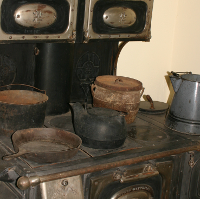
Old-fashioned stove with many pans, pots and kettles on it

Is that stovetop gettin’ a mite crowded?

After tonight’s game (a fun take on the standard train robbery scenario), we briefly listed what games we currently have on the back burner:

  1. Eric’s Blade & Crown game. The two main PCs (here’s mine) had managed to become members of a pirate crew, and were working their way back towards Morensia to raise an army and defeat the brewing Two Suns/Three Suns cult. I’m still raring to play more of this; my character is fun, her interaction with John’s character is fun, I like the setting (Eric’s take on my Morensia background), and of course I just like playing Blade & Crown.
  2. The Alwyn campaign. John’s Fate game set in the far future Twin Cities, with a sorta post-apocalyptic civilization against the background of a Babylon 5 universe.
  3. “40 Microscopes“, as Bob put it. We’ve played quite a few games of this, and frequently said “Wow, I really want to revisit this world sometime” when we’re done. Except every time the player composition seems to be different, or I’ve forgotten the other sessions’ cards, or something, so we end up doing a new history.
  4. Owl Hoot Trail. We did a starting scenario of this and are planning more sessions.
  5. Diaspora. Our main game, set in a cluster we designed. I no longer remember what we were doing in this game, though I’m sure looking at my notes would help. However, as we discussed tonight, playing in this cluster might not be much fun, because the player makeup is different and part of the point is to play in a cluster of the group’s own devise.
  6. Diaspora: the generation ship. This was quite a fun adventure, but it appears that we’ve reached a logical conclusion. I bet we could do more with this, but maybe it’s complete as is.

That list is sort of in order of my preference for bringing games back off the burner; I’d definitely like to revisit Eric’s B&C game sometime. It would also allow for new players to join in easily, because we’ve got a whole pirate crew from which to find new allies. But all these games would be fun.

By contrast, my monthly group only sort of has one game on hold — my Spheres campaign. But we haven’t run that for years, and I feel like it’d be hard to pick back up. Not to mention that I haven’t felt like running SF much in the past half-decade or so.

Edit: Here are three more I’d forgotten to note, as mentioned in the comments:

  • Viking Barsoom. Inspired by one of our many Microscope histories, I think the genesis of this was the phrase “Space 889”.
  • Dogs in the Vineyard. We played this relatively straight, with the PCs as troubleshooters for a socialist commune. This is still ongoing, if I remember right, although I think it reached the end of the first scenario.
  • Og. We’ve usually played this as a one-shot, but there’s one group of characters who’ve been through a few (mis-)adventures together.

So we’ve got about nine games on the back burner, it seems.

New Fate dice: nice!

While I was at the Source to see B&C on the spinner racks, I got a set of the new Fate dice. The Core set, specifically, with translucent green, blue and purple dice. You may have noticed that I like purple a lot, and translucent purple is my standard preference in dice. So having a set of Fate dice that match my aesthetics is very nice, and they glow beautifully in sunlight.

Fate Core dice in sunlight

I’m a little confused as to why they put the markings such that opposite sides add to 0. With the + sides next to each other, it seems that manufacturing defects such as uneven plastic distribution could lead to a die being more likely to roll + or -. The previous set of Fate dice I got had +’s opposite from each other, -‘s opposite and 0’s opposite. Seems more likely to be fair, that way. Then again, a standard D6 has opposite sides add to seven, with high numbers clustered next to each other and low numbers next to each other. So maybe there’s some mathematic or manufacturing reason for it.

Regardless, they’re very pretty dice, and my enthusiasm for playing Fate is now even higher!

Blade & Crown back on the spinner racks

Blade & Crown for sale at the SourceThe Source has had Blade & Crown on sale in their bricks-and-mortar store since late last year. However, I noticed later on that they’d overpriced the book. I gently pointed this out a few times, and they’ve now got B&C at a correct price. They moved it back to the spinner racks to note the price correction; John noticed this first, and I thought I should point it out here. If you looked at Blade & Crown before but balked at the expense, now’s the time to go buy it!

Lego minifigs for RPGs

If you need miniatures for gaming, there are a lot of options out there. Metal or plastic minis; tokens or counters; cardboard standups. One of my favorite solutions, though, is Lego minifigs.

They’re a bit too cute and cartoony, and their proportions aren’t realistic. They cost about the same amount as gaming-specific minis. They aren’t totally stable, so they fall over easily without proper basing. And there are probably fewer total minifigs available than there are purpose-built minis for gaming.

Beyond that, though, they’re just generally great. They stand about the same height as 25mm figures, so they work fine on just about anything scaled for 25mm. There’s a good variety of minis available, at least, and it’s growing all the time; seems like Lego comes out with a new fantasythemed line every few years, and they have many other themes: SF, superheroes, pirates, steampunk, 1920s, modern, ninjas, etc.

Sorting tray full of Lego minifig parts

My Lego parts for fantasy gaming

One of their best features is that they allow for vast customization. There are all kinds of accessories, including computers, briefcases, clothing and armor, rope, etc. There are tons of different kinds of weapons and shields (even before you count third-party makers of Lego weapons). They even have a quite good approximation of a certain valuable idol. You can easily customize an entire new minifig from the body parts available there, and it’s easy to mix different torsos, heads and legs.

In fact, the customizability is so good it’s almost a liability. Presented with such vast possibilities, players want to spend a good long time looking for just the right torso or satchel. And many times, when I pull out the minifigs for the first time, the players’ eyes go wide: it’s often been a long time since they’ve played with Lego, and getting to do it again, they go wild. I’ve fairly often had to impose a time limit on customization: “Five minutes and you go with what you’ve got”!

As I mentioned, another slight liability is that the minifigs tend to fall over when standing on their small feet. Luckily, that’s easy to solve; I just keep a large quantity of 2×3 base plates on hand. (See examples of 2×3 base plates in the photo below.) I plant each mini on one of these base plates, and the figure then stands quite stably, at least if its leg joints are strong.

Plastic tray of Lego minifigs

Pre-assembled minifigs and other accessories in tray

The other trick to using Lego minifigs is keeping them organized. So far, the best system I’ve found is keeping them in several trays, like the ones in my photos. I usually keep two types of trays with me: one of just parts, one of largely pre-assembled minifigs (for NPCs and players’ long-term PC minifigs). It works pretty well.

And Lego minifigs work pretty well in general. Customizable, widely applicable, affordable — they’re a great gaming accessory, one that more people should consider.

Fictional nonfiction I: What is this genre?

Image of a fictional worldThere’s a genre that I love very dearly, and which I’ve already talked about in some places on this blog. Here are some examples of the genre:

These are basically reference works without plot for places that do not exist. They are pure worldbuilding sans plot. They are, as I usually think of it, fictional nonfiction. There are many, many more examples of the genre that I haven’t described.

It’s really quite an amazing genre: full of interesting details, eye-opening vistas, erudite speculation and limitless possibilities. It’s all the more amazing for not having a common name. I usually refer to the genre as fictional nonfiction, but other terms appeal at other times.

Like all genres, it gets fuzzy around the edges. Are David Macaulay‘s books such as Castle and Pyramid, with their minimal characters and scant plots, fictional nonfiction? What about books such as the Dune Encyclopedia or Dictionary of Imaginary Places that describe things found in prose fiction without directly relating the plots? The Hitchhiker’s Guide to the Galaxy might fit, at least if we’re talking about the encyclopedia-like entries rather than the real-world media (radio show, book, movie, etc.). The Encyclopedia Galactica — Adams’, Sagan’s or someone else’s, take your pick — is another strong candidate for this genre, though we only ever see tantalizing snippets. Much of Borges’ work seems to dance along the line between this mostly unnamed genre and standard prose fiction. The Codex Seraphinianus probably fits this category, though with its incomprehensible script (possibly a conlang), it’s hard to tell. Similarly, the Voynich Manuscript may also fit, though until it gets deciphered, we won’t know for sure. Ursula K. LeGuin’s Always Coming Home intermixes a thin plot with anthropology (songs, recipes, myths and more) about a fictional far-future culture of central California. Many computer games, such as Sim City, probably fit in here somewhere.

Nonetheless, I think it’s pretty clear what the characteristics of this genre are: reference materials, whether encyclopedias, atlases, dictionaries, travel guides, cookbooks, hymnals or whatever else, for worlds that do not exist. One of the most important characteristics of this genre is that it is not prose fiction; it isn’t primarily about narrative (unless you use a definition of ‘narrative’ so broad as to be useless). And as I’ve mentioned before, I think that pure worldbuilding with no plot is worthy in and of itself. I think a big part of why this genre doesn’t have a clearer popular definition is that it’s often considered to have less prestige than prose fiction. Hopefully this post will do something to help destroy that misconception.

There are a few other interesting characteristics of fictional nonfiction that I’ve noticed, and I will eventually post more about them on this blog. Yep, it’s yet another multi-part series! Maybe I should just call them ‘themes’ instead…

The D&D movies

For such a successful game, it’s funny how unsuccessful the (official) D&D movies have been. Part of it is probably just popular disdain of gaming culture. Most of it, though, is probably the fault of the first D&D movie. It is pretty unrelentingly terrible. Bad dialogue, bad plotting, plot holes, clumsy inclusion of RPG tropes, some really pretty repellent messages if you think much about it… It has some redeeming qualities, but the overall impression is just bad.

I’ve watched a bit of the third movie, and it’s really quite awful. They decided to use evil main characters, which could be interesting, but it’s clear that the movie itself is pushing a rather slimy agenda. I stopped watching after a completely gratuitous sex scene.

Cover of D&D: Wrath of the Dragon GodWhat I really want to talk about, though, is the second movie, Wrath of the Dragon God. Unfortunately, the second movie seems to have been polluted by the reputation of the first one. Unfortunate, because the second movie is actually pretty good. Low budget, to be sure, but it’s an improvement over the first one in almost every way:

  • The story is not only coherent, it’s kind of clever in places. Finding the goblin village ransacked, the mirror trap and the lich’s betrayal are all creative moments. Some things happen slowly and dramatically; others happen suddenly, keeping a fresh sense of pace.
  • All the characters get to contribute something important, and there’s a good amount of character development. The women characters have as much agency as the men. (Indeed, Melora’s story is just as important as Berek’s.)
  • At the same time, the movie dares to kill primary characters, giving a sense of real danger.
  • Some of the dialogue is pretty good. The thief, especially, gets some good lines, such as taunting the barbarian about what drove her brother insane at the Barrier Peaks, and getting the rest of the party to look away while he handles a not-actually-complex device.

The movie also has a lot of relatively subtle inclusion of D&D tropes, such as that offhand mention of the Barrier Peaks, and how the mage can’t teleport somewhere because she’s never seen it. It makes the D&D meta-setting make a fair amount of sense, which is something of a feat.

The commentary track by three PCs is inspired, if not perfectly executed. It’s basically D&D characters lampooning the exploits of the D&D characters onscreen. It’s a little unclear what tone they’re going for: mockery or sincere admiration? But having D&D characters do an MST3K track for a D&D movie is at least a great concept.

Another of the special features is a fairly long talk with Gary Gygax talking about the movie. He mostly just praises it, in a way that feels more like an ad than an interview, but he still gives a few insightful comments on the movie. And there’s a making-of featurette that shows how much they studied D&D while making the film; the actors used the PHB and other books as direct reference materials to understand how the world and their characters were supposed to interact.

All in all, I’d say that not only is Dungeons & Dragons: Wrath of the Dragon God the best of the three D&D movies, it’s actually a pretty good movie overall. If you’re looking for an inspirational fantasy movie and watching Lord of the Rings again isn’t cutting it, D&D 2 is not a bad choice. It certainly doesn’t deserve the spillover disdain that it gets from the rest of the franchise.

The Bandit Map: Playtest done!

Small section of an adventure mapThis past Thursday night we finally finished playtesting The Bandit Map, the adventure for Blade & Crown that I hope to have out soon.

The scenario was pretty fun and this session, the last, involved equal parts silliness and seriousness. There were some really cool PC actions and dramatic moments. One character used a long-winded religious sermon as a combat maneuver, then piously and chivalrously allowed an NPC opponent to change weapons in the middle of combat. Another character used a combination of weird dancing and spooky magic (described as feeling like centipedes) to seriously mess with the mind of the big bad NPC. One character was always Aggressive in combat, adopting a grave berserker attitude; another made the big bad NPC pay for messing up one of his most dramatic moments. The players were getting good use out of their Traits, both positive and negative. There was an exploding barrel of oil, much use of smoke, some rescued prisoners and (a personal favorite) a very dramatic moment where it was unclear if the final confrontation was going to be with words or swords.

Most importantly, I got some good feedback on what worked, what the players wanted to see more of and just generally ways to make the scenario even better. I’m still hoping for publication in the next couple months — keep watching this space!