…and a quiet week

Already five days without a post… Real life has been keeping me extremely busy the past few days, with no time for a real post here. Hopefully I should have more this weekend. In the meantime, how about an aphorism?

The best strategy is the one that makes your opponent change their strategy.

The Quiet Year

This Thursday, Real Life intervened again and we were short a player. Had been hoping to finish our playtest of The Bandit Map, the Blade & Crown scenario I’m playtesting. Instead, we played a game that one of the players bought at GenCon: The Quiet Year.

It’s a small, interesting game. (Small? Literally. It comes as a tiny pamphlet and pack of playing card-like cards.) In it, the group works together to draw a map of a community that has survived conflict with the Jackals. What exactly the Jackals are is left up to the players. The community has one year, one Quiet Year, before the coming of the Frost Shepherds. The identity of the Frost Shepherds is also left up to the players.

The centerpiece of play is a map that everyone draws together. It can denote physical locations — a water filtration plant or ancient ruin — or more figurative objects such as a spiritual inquiry. The map gives the game a feel of being a boardgame, though it’s definitely a story game. With the various projects going on and the detailed sense of history, the game also seems strongly reminiscent of games such as Advanced Civilization. The map works in interesting ways; I could tell you what all the symbols on our map mean, but they might be meaningless to you. As with other RPGs, the map is for the people playing it, while they’re playing.
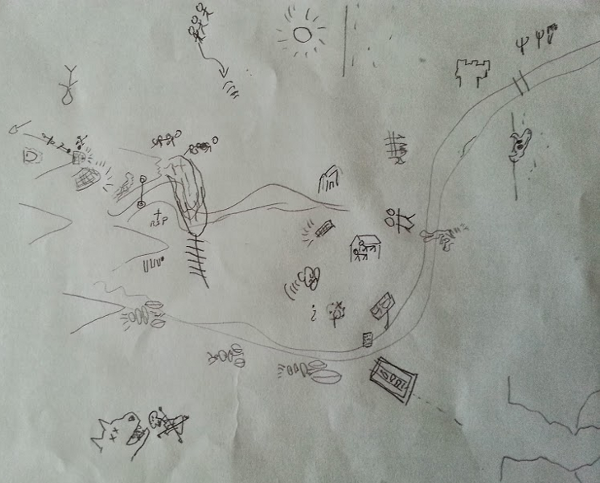
Map from Thursday's game of The Quiet Year

John has a great review up at the Everwayan. He notes a few things about the game we all found interesting; foremost for me is how Discussions work. They are one of the three actions a player can take at the end of their turn (the other two being Discovering Something New, or Starting a New Project). Discussions serve to get issues into the open, but — much to our amused realization — those discussions don’t actually resolve anything. To make actual progress, someone needs to discover something or start a project. Contempt (which is a direct mechanic in the game) may grow when people’s opinions are given short shrift in Discussions. It’s an interesting simulation of how communities work.

I was a little at a loss for how Discussions are supposed to work, however. Each player voices an opinion, and if the person who started the Discussion began with a question, they get to voice the last opinion. However, it was unclear a) how roles in the community are doled out, and thus which sides we should take in Discussions, and b) how exactly Contempt is supposed to be meted out. The rules say points of Contempt can be eliminated to heal over arguments, but the mechanics on this are a little unclear. Thus, it doesn’t seem like there’s much reason to take points of Contempt. And especially here in Minnesota, openly declaring Contempt is a difficult thing to do.

It might be interesting to see a mechanic where players decide at some point (perhaps as denoted by the cards, or by some use of the Contempt tokens) which factions they represent. One of us might be the stodgy council of elders, another might be the youthful rebels. Of course, it’d be important for this to be open to change — another possible use for the Contempt tokens: “The Council of Elders is so full of rage that it splits, and a new faction emerges, the Old Progressives”. This would give players a bit more structure to hang Discussions on, and allow for more integration of Contempt tokens.

Of course, the point may have been that Contempt does nothing, only serving to increase tension in a community without resolving anything. And that would be a good point!

One more reason RPGs are cool

In case you needed it, here’s another reason RPGs are cool: because they make you want to learn everything. RPGs (and worldbuilding, and working to make rules model the world) have made me curious about how pretty much everything works, from the swarming of insects to the manufacture of swords. It’s rare that I learn a new fact and don’t, somewhere in the back of my head, have the thought “this will be good to know for a game, someday”.

Another new FLGS: Mead Hall

Minneapolis is kind of an amazing place. I’ve lived in other towns and been happy to find that there was a gaming scene at all. I’ve lived in places where the nearest FLGS wasn’t very L at all, often being an hour drive or more away. But in Minneapolis, there are so many FLGSs that I literally can’t keep track of them all. Tonight was a case in point. While wandering around looking for a particular restaurant, I discovered that there’s a new FLGS in town: Mead Hall Games & Comics. They’re located at the corner of 15th Street and LaSalle Avenue, near downtown and Eat Street.

The fine sign of Mead Hall

It’s a pretty cozy basement space, with a few dozen games, primarily boardgames, and a rack or two of comics. Their RPG section was one shelf, mostly D&D. But they had a good selection of Magic: the Gathering supplies, including a nifty old-style card cabinet converted into filing for M:tG cards. The place was hopping with Friday Night Magic players — probably a couple dozen. (It’s possible they’d cleared away more games & comics than I saw — I didn’t stick around to chat much.)

I chatted with a couple staff people, and they said they’re in the process of putting in nice wood floors, and that they’ve only been open a year, so there are clearly great things in their future. I bought a pack of D10s — I always try to support FLGSs when I can, especially when I first discover them — and headed off to the restaurant, but not before taking a few photos.

Here are a couple of the staff busy with business.

Two of the staff busy running the business

They have outdoor gaming space! How cool is that?

Photo of gaming space outside Mead Hall, outdoors and under decorative lights

I haven’t done calculations, but I think Mead Hall may now be the closest FLGS to my house. Sometimes I really love the gaming community here!

Astronomy in gaming, part II

Small section of the night sky on a fictional worldIn my last post, I explored some ways in which you can make the astronomical properties of a conworld unusual and interesting. Astronomy can have interesting, evocative, creative effects on play, too. Here are some impacts it can have:

  • Shaping the way people live: I know of at least two conworlds where the night sky is completely devoid of stars. This could lead to a sense of hopelessness, or one of rugged individualism. And how does it affect psychologies when the sun is always in the sky (as in summer in high latitudes) or never in the sky (winter in high latitudes)? What if the sun were always present? What if “day” and “night” were caused by pulsations of the sun, rather than rotation of the planet? What if the moon were visibly creeping closer to us — would that lead to foreboding, or joyous exultation? It’s easy to imagine any of these variations causing a hundred rippling effects through the lives of people in those worlds, from psychology to agriculture.
  • Shaping navigation: This aspect of daily life has especially strong astronomical connections. In the real world, the sky can give you a very specific sense of latitude, if you know how to read it. And if you have a good clock, you can tell your longitude as well. What would it be like in a world with nothing at all in the night sky? Perhaps travelers would avoid nighttime travel altogether, lest they become lost. What if the stars moved visibly on a day-to-day basis? Navigation might be a vastly more convoluted, and esoteric, skill.
  • Informing the sense of place: In addition to helping or hindering how you get to a place, it can help shape your sense of that once you’re there. Different areas within a world are likely to have different approaches to the sky, often reflecting variant cultural mores. If the moon(s) resemble those of Earth, then months are likely to map closely to the orbital cycles of moons, regardless of place; that’s the derivation of the word “month”, after all. But different places may have different calendars, leading to discrepancies in what date someone thinks it is, or even what year. A culture’s constellations are likely to betray some of their cultural values. If the “Flaming Dragon” is rising in the East, that may be reason to stay only in stone houses for a month or two… And in our world, different latitudes see different stars, meaning it’s very hard to see the Magellanic Clouds if you’ve never been outside the northern hemisphere. Being able to see stars, nebulae, planets, even moons that you’ve never been able to see elsewhere can make a foreign place seem all the more foreign. But seeing the same moon can remind you of home. Describing the night sky can greatly help the sense of immersion, and the sense of the world as a distinct place.
  • Affecting character generation: The positions of the stars could have direct mechanical effects on a character’s innate abilities. The primary example of this I can think of is HârnMaster, where a character’s skills are directly affected by the star-sign they’re born under. And of course Blade & Crown allows characters to be Fated, which could be derived from astronomical influences. Can you think of other games where astronomy or astrology comes into character generation?
  • Affecting abilities during play: Many games give astronomy an indirect effect on play, often through the form of giving bonuses to certain rituals when performed on appropriate holy days. This came up in a recent thread on RPG.net about games where the calendar has a mechanical effect during the game. But I can imagine a game where even more astrological effects come into play: presence of given constellations in the sky, planets within certain constellations, eclipses, etc. This would be especially easy in a system with free tagging, such as FATE.
  • Soothsaying and fortune-telling: ‘Disaster’ originally meant “bad stars”, and it’s easy to conceive of various astrological effects on a character’s fortunes. As I mention in Blade & Crown, this is a great way to use changes of Traits in play, as they are inspired by astronomical phenomena.
  • Creating tension through timing: Confluences of astronomical phenomena may allow, or disallow, certain events. Perhaps the Portal into the Mountain-Queen’s Realm is only open on the equinoxes; or the only way to fulfill the prophecy is to “let a thousand stars fall” by waiting for a meteor shower; or the magical staff only draws power from the light of the Four Moons shining together; or the curse can only be broken on a day without night. These can all lend tension of timing to a situation. Of course, like any time-restricted events, they can lead to the PCs waiting around for the right confluence, or missing the confluence entirely.
  • High-powered adventure locales: If your characters are getting too big for their britches, a voyage to the moon might be fun!

What other uses have you found for interesting astronomy in your games? SF settings almost don’t count, with their unusual astronomical phenomena so frequently found all over the place, but I’m curious about whatever setting you’ve thought of!

Astronomy in gaming, part I

Small section of the night sky on a fictional worldWhat does the night sky look like on your gaming world? What, for that matter, does the daytime sky look like?

A few weeks ago, I was in a place where the night sky is truly amazing — at least when the clouds don’t impinge. The Milky Way is just right there, the Pleiades are big and beautiful, some of the globular clusters and galaxies are naked-eye objects, the entire sky is full of stars. It’s always wonderful to be reminded of what a beautiful universe we live in. And it reminds me of how interesting it can be to consider astronomy when you’re building worlds.

I suspect that in a lot of worlds, astronomy doesn’t really enter into it. Like biology or geology, we assume that a conworld has basically the same features as the Earth. There’s a Sun that goes around once a day, a single Moon that goes around once every 28 days or so, stars twinkling, etc.

And I suspect that there’s another category, just about as large, where the astronomy differs in a few standard ways: there are two moons, there are two suns, etc. With a lot of these, the astronomical differences still don’t mean much — they’re reminders that this isn’t Earth, but they don’t have much practical effect otherwise.

What ways are there of creating variant astronomy with interesting, unusual effects?

Well, before I get further into this, I should make it clear that I don’t think everyone needs to detail the astronomy of every conworld in some original way. Sometimes, standard tropes are standard for a reason: they work, they signal things in a simple way and they are evocative without requiring infinite work. And even if you want astronomy to come into it somewhere, it can be something the group devises after play has begun, perhaps left fallow for a useful, dramatic moment.

And I should also say that I’m going to stick to relatively plausible variations here. Could the night sky be full of rainbows and exploding candies? Well, yes, but if I start listing the more far-out variations, I’ll never stop.

Ideas for variations:

  • The Sun: As I mentioned above, a standard trope is to have more than one Sun. What other variations are possible? Perhaps a planet might orbit a brown dwarf, leading to a very dim sun (and perhaps creatures adapted to seeing in infrared instead of what we consider visible light). Or orbit a vast giant, leading to horrible daytime temperatures. Or orbit with high eccentricity, leading to extreme seasons. Or have extreme axial tilt, also leading to seasonal extremes.
  • The Moon: A lot of interesting variations are possible here. A world with no moons of appreciable size would have no tides. A world might have a net of tiny moons orbiting in complex ways. One of my favorite ideas is having a moon that itself has a biosphere. Calteir has a moon, called by some the Veil, which is mostly covered in clouds; only occasionally do complex blue, brown and green shapes appear behind the veil of white. (The moon itself is habitable, but I’ve never had a game become high-powered enough for the PCs to visit the Veil.)
  • The night sky as a whole: Perhaps there are no stars at all in the night sky. Or there are only a handful of stars; or there are only stars in one section of the sky; or the night sky is so full of nearby stars that people talk of the Single Sun and the Many Suns (as might happen if the world orbits a star within a globular cluster).
  • The Galaxy: Perhaps the world is embedded within an elliptical galaxy, leading to well-distributed stars in every direction with no noticeable ‘Milky Way’; or perhaps the world orbits a sun outside the main body of a galaxy, leading to a large galaxy viewable, as a whole, in the night sky; perhaps the world sits near-ish the central supermassive black hole of a galaxy, making for a great accretion disk and giant ejecta jets in the night sky.
  • The Planets: Perhaps the planets all orbit closer to the Sun, meaning that they always appear as Morning Stars or Evening Stars; or perhaps they all orbit further out from the Sun, meaning they can be in any part of the ecliptic. Perhaps all the planets have such unusual orbital inclinations that the none fall near the ecliptic. Perhaps the world is itself a satellite of a much larger world, leading to interesting orbital mechanics and both a Sun and a Primary.
  • The Pole: Our Earth has a star very close to the northern pole, and nothing in particular close to the south pole. (This situation has not always been so, of course.) Perhaps in your world, rather than a pole star, there is an open cluster or galaxy at the pole. Or nothing at all (as in the southern hemisphere of the Earth), making life harder for navigators.
  • Other astronomical phenomena: Looking at the real night sky with our naked eyes, we can see a few open clusters (such as the aforementioned Pleiades), five planets, two or three galaxies (from the northern hemisphere, only M31 and our own), and one moon. And, if we have really good eyesight, perhaps a nebula or two, and maybe one or two more galaxies. But imagine what other interesting phenomena could be present in the night sky of a conworld: the tenuous layers of a planetary nebula, the strange spreading shapes of a diffuse nebula or supernova remnant, the dark majesty of a molecular cloud, or the speckled glory of a close-in globular cluster.
  • Changing phenomena: In our night sky, the planets and moon move regularly. Meteors occur at semi-random intervals. Once in a lifetime, there may be a comet visible to the naked eye, and even more rarely, a supernova. At extremely rare moments, it might even be possible to see lunar impacts. But the stars, Milky Way and much more largely remains the same. What would it be like if this were not so? A planet near a globular cluster might see its stars move in obvious ways; a planet near a planetary nebula might see new layers slowly creep out. A planet with a ring and shepherd moons might see the ring wobble or twist on a daily basis. If our world orbited a star relatively near a black hole, we might see the night sky slowly (or maybe even quickly) lensing. Perhaps relativistic jets seeming to move towards us or away from us, too, as our star orbited.

Next time, a bit about some of the effects astronomy can be used for in gaming.

MetaCon?

Way back at Con of the North, I think it was, I picked up a flyer for a new convention in town: MetaCon.

It looks like MetaCon is primarily about anime and manga, but with a lot of other, more general SF fandom: they list steampunk, science fiction, video games, music and other interests. And it’s running a week and a half from now, August 30 – September 1.

Two warning signs for me with MetaCon: First, they talk about attending in terms of “tickets” and “passes”, rather than “memberships”. My favorite cons are always those that, instead, put it in terms of “memberships”. If I’m a member of a con, I feel like me and my fellow geeks are creating the con by celebrating our geekiness together. When we’re all members, the con is not just for the people attending, but by the people attending. Big-name guests may be a feature, but they’re not the focus. Everyone who’s interested can be on a panel. Celebrating our fannishness together. That sort of thing. But when a con starts talking about “tickets” and “passes”, that makes me think they’re viewing their attendees as passive consumers of entertainment — people at whom fun will be shoveled. And talking about “tickets” also makes it sound like the con is being run for profit. These are all hunches based on past experience, of course, and I don’t know if this is how MetaCon actually runs. But it does make me a bit hesitant.

The second thing that makes me hesitant: their website isn’t as well organized as it could be. Their “Card Gaming” page (which apparently would be better called the Tabletop Gaming page) directs you to the “Events” page for the actual schedule. That page requires clicking another link to get the actual schedule. And for tabletop, the schedule lists only “open gaming”.

However, aside from those two things, it looks very promising. It’s only in its second year and already boasts 2000 attendees. Some of the panel topics look interesting. The con seems to have a lot of energy and enthusiasm. And really, some website difficulties and weirdness over terminology may also be because they’ve only been doing it for two years. Their parent organization says it’s by fans, for fans, so hopefully any warning signs I’m seeing are false alarms.

Realistically, I won’t be attending anyway this year, because that weekend will be very busy for me. But I hope MetaCon grows well. I hope to attend MetaCon 2014, and I’d love to hear reports from anyone who goes to MetaCon 2013.

How to invoke that item?

Image of a mystic glyphHow do you invoke an enchanted item? I always want magic to be evocative, and to help the players become more invested in the situation. For those reasons, just saying “I use my staff on the bad guy” seems… boring. What interesting ways are there to invoke an enchanted item?

Here are a few ideas:

  1. Kindly ask the item, in an ancient tongue, for what you wish it to do.
  2. Compose a poem demonstrating to the Powers of the item how deep your commitment is.
  3. Repeat the names of everyone who has ever owned the item, giving special emphasis to those who used it as you intend to now.
  4. Burn a cube of incense, take some of the smoke into your mouth, and speak your intentions while blowing smoke onto the object.
  5. Engage in epic debate with the Powers of the item, convincing them to help you with as few preconditions as possible.
  6. Hold the item up to the constellation of the Great Ark, such that you can see the light from the three brightest stars of the constellation through the gems of the item.
  7. Immerse the item in water gathered at the confluence of three great rivers.
  8. Describe how you enter a trance while holding the item, and the various pleasant fragrances it emits as it takes effect.
  9. Do something kind for someone while holding the object.
  10. Draw a mystic glyph in the ground with the item, and draw it for your fellow players to see.
  11. Use the item as a musical instrument and compose a song describing your wishes.
  12. Use one of your Traits and explain how this force of personality helps drive the enchantment.

What to run at Con of the North 2014?

A compass roseCon of the North, the main gaming convention ’round these parts, has sent out the call for games for next year and (like the Everwayan) I’m considering what to run. Here are possibilities I’ve got stirring:

  • A murder mystery set in a monastery. This would be in Calteir, my main fantasy world, and use Blade & Crown. Clear inspiration from The Name of the Rose here.
  • Tenement Defense, the scenario I’ve described here before in which the PCs are a group of people living in a tenement, defending their home from rampaging adventurers. This would also be set in Calteir and use Blade & Crown.
  • Microscope. Nearly no prep, and it can always be fun, given the right group.
  • Og. This could also be a lot of fun in a con, assuming people can get into the right mood.

Not sure what I’ll go with yet… What do you think?

Blade & Crown: What magnitude of nodes?

Wheel of magic in Blade & CrownA question came up in last Sunday’s session of Blade & Crown: what’s the maximum magnitude of spell that a mage can align a node to? That is, if I know Metal Magic to level 3, can I align a node that’s magnitude 4? Could I align a magnitude 4 node to a lower magnitude spell and let the ‘excess’ magical power just go to waste?

As I was writing the game, I had in the back of my head the idea that a mage could only align nodes up to the level of their Magic spell. That is, that if I have Metal Magic 3, I can only use (align, cast, etc.) spells up to Magnitude 3. I also intended that higher-magnitude nodes are simply unusable by someone with a lower Magic skill than their magnitude.

However, as I checked what I’ve actually written in the rules, I don’t think I stated this anywhere. And thinking about it a little more, I think it’s probably enough to have large penalties to align nodes that are of high magnitude. If you want to align a Crystal node of magnitude 5 when your Crystal Magic skill is only 2, it feels right that you should be able to attempt it — and possibly suffer horrible consequences. I could see the argument that allowing any mage to align a node of any magnitude could lead to magic being overpowered, but I think it’s well balanced by the inherent danger. Allowing mages to (in principle) try anything, even highly dangerous tasks, accords with the principle of making magic rare, mysterious and powerful, I think.

Ultimately, of course, this is up to your group and your play-styles. What are your thoughts? How do you approach this in your games?