Reading RPGs

Illustration of a bookJudging by posts on RPG.net, a lot of the RPGs sold these days primarily get read, put on a shelf, occasionally referred to, read some more and never actually played.

Unlike a lot of people, I don’t think this is a bad thing. Not fundamentally, anyway. People enjoy themselves in many different ways. If someone has fun reading about a setting, or imagining themself as one of the canon characters, or dreams of running campaigns in the game world (but never actually plays in it), I see almost nothing wrong with this. Fun is fun, so long as you’re not hurting anyone.

(The one problem I could see with this is if RPG designers start designing games primarily to be read, not to be played. Some games seem like they’ve moved in this direction, but I’m not at all convinced that it’s a major problem in the industry.)

And yet a lot of people make a sort of ascetic argument that the only legitimate way to enjoy an RPG is through actual play. No one should own any games that they don’t use; strip away everything that isn’t ‘necessary’; winnow your collection down to X number of systems; so the argument goes.

It feels a bit like this attitude comes from the same place as the “all worldbuilding must get used on the players or it is bad” idea. Specifically, it comes from that same attitude that everything must be “useful” and “accomplish” something. ‘If something only looks pretty but never accomplishes anything tangible, it’s useless.’ ‘If you know a fact but never use it, learning it was a waste of time’ — and general anti-intellectualism coming from this. Those kinds of ideas. If it’s not clear, I disagree with those ideas; fun is worthwhile, and not everything needs to “accomplish” tangible “results”.

It also feels like this attitude is yet another exercise in geek self-loathing. Humans find reasons to look down on others, and on themselves. Geeks are certainly no exception to this, what with the myriad ways geeks find to look down on one another. Some gamers look down on others who only read games; I’m pretty sure there are also people who read games and never play them because they’d never stoop to actually playing those silly things.

One criticism I can kind of understand is that owning a ton of books is a waste of money and space. If you’re just obsessively hoarding multiple copies of books with no intention of actually using any of them, that could be harmful — to your budget, to your relationships, to your ability to find a place to sleep, etc. It’s important to respect your budget and balance gaming purchases with other areas of your life. None of us should feel pressured (either internally or externally) to buy more than we can afford. But still, buying lots and lots of RPGs could just mean that you get more enjoyment out of dealing or collecting than playing, which is a legitimate way to be. Again, I hope the industry doesn’t become slanted towards this particular way of enjoying RPGs, but I don’t think there’s a real danger of that.

Another criticism of reading books rather than playing them, one I make myself, is that it can be easy to fall so in love with canon that you either feel a need to info-dump all of it all your players, or that you’re unwilling to change it. I’ve had two GMs now, one in a GURPS Traveller game and one in Hârn, who had vast collections of their chosen settings. They had a hard time not showing off their collections, in fact; any slight offhand mention of a detail in one of the books would often mean a fifteen-minute derail while they hunted down the precise facts in some obscure supplement, even if it was almost completely unimportant to the game in progress. It seemed that they felt guilty for enjoying their large collections, and their guilt demanded that they exposit at their players as much as possible to make it feel like their collections were actually ‘useful’. In fact, I’d say they were so enamored of canon that they were unwilling to let the PCs change anything. Because of that, nothing meaningful could happen in the game, and “adventures” basically consisted of sightseeing expeditions through static worlds.

That’s not to say that loving canon is inherently a bad thing. I love Hârn — I sought out that campaign because of it — and there are a lot of other published settings that I enjoy reading immensely, too. That enjoyment is just as legitimate as the enjoyment I get from actually playing in published settings. The thing is, those two forms of fun shouldn’t, and needn’t, come in conflict. It’s possible to love canon while still allowing it to flex where the game requires — and, of course, I think most people do this. It’s also possible, if you love canon to the extent that you’re not willing to let PCs mess it up, that you just enjoy reading those RPGs and not playing them. That is also a completely legitimate way to be, but it’s then important to recognize that fact and then communicate that clearly to potential players.

Also, not everyone has gaming groups that are infinitely flexible. When I was in Taiwan, finding people willing to play HârnMaster, for example, was like trying to find hen’s teeth. Poring over gaming books was the one form of enjoyment I had with them at that time. And even if you’ve managed to find a group who have compatible personalities, schedules and tolerances for Monty Python jokes, it’s unlikely that you’ll all want to play all the games you’re interested in. Even if you were, it’d mean playing each game for only a short time.

I feel like gaming in general would be better if people could admit that reading RPGs is a fine way to enjoy them, as is playing them. There are many wonderful ways to enjoy RPGs, all legitimate.

Approximate that hypotenuse

Ever found yourself wanting to approximate a hypotenuse quickly? Probably the most common situation where this happens, at least in my experience, is when you want to know the range between two combatants on a battle map when one is at a different altitude. You don’t always want to use a calculator in play, so what do you do instead? Is there a way to quickly approximate √x2 + y2 in play?

I’ve thought of and used a couple different approximations over the years, but yesterday I thought up one that’s really quite good:

For two numbers X and Y, where X ≥ Y, ((X * 2) + Y)/2 ≈ √x2 + y2

That is, add X and X and Y, then divide the result by 2. So if you’re trying to find the hypotenuse of 3 and 4, this formula gives an approximation of ((4 * 2) + 3)/2, or 5.5, and the actual answer is 5. Not bad for an on-the-fly answer.

Matt pointed out that if X ≥ 2Y, it’s actually more accurate to just use X straight up as the hypotenuse. So if X is 20 and Y is 5, the formula’s approximation would be 22.5, the actual hypotenuse would be 20.615…, and the approximation would be 20. Even better.

If you end up using this in a game, let me know!

Items: Random provenance

Photo of inscribed skull

Mysterious history

For an enchanted item to have amazing powers is fun. But at least as much fun can be discovering the history of the object. Finding out that your sword makes a high-pitched keening sound when you’re near water is neat, but discovering that it makes that sound because the first owner was a blind fire elemental can be just as interesting.

With that in mind, here are some ideas for item provenance:

  1. The item became covered in dirt and was eventually painted over. For many years, it was considered a mundane object of its type.
  2. The item became the marque of royalty for a goblin clan. Would-be chieftains fought over it for many years. The object now has a slight bluish tinge from all the goblin blood spilled on it.
  3. Through many hands and much history, the object has slowly been working its way east. It seems to become more powerful when it goes east, and its owners seem to be more accident-prone when it goes west.
  4. The item once helped an evil person become good. Later, it made a good person evil.
  5. The object spent many decades in the vaults of a temple, where it was considered a powerful relic. Later, it was liberated in a religious uprising, and spent several more decades hidden behind the idols in a roadside shrine.
  6. There was a long period when three powerful people all maintained that they owned the true version of the object. It is extremely difficult to determine who actually possessed it; official histories give completely contradictory accounts.
  7. The object was once part of a much larger object, from which it was forcefully separated. It will become far less powerful if rejoined with its earlier fraction, however.
  8. A series of romantic tales all seem to relate to the object somehow.
  9. The object has its previous owner’s name inscribed on it. Close inspection, however, will reveal that an even earlier owner’s name was excised and the new inscription made over that.
  10. The object was used by a traveling performance troupe as a prop for many years; only after it was stolen by a famous thief did the troupe realize that they had had the real thing.
  11. Its owners seem to be very lucky for fifty years, and then very unlucky for another fifty years.
  12. The object was mounted above the fireplace of an inn for dozens of years. The innkeep considered it a prize, but eventually donated it to a wandering adventuring party, who managed to get themselves killed and the object lost.

Blade & Crown: The Bandit Map

Cropped illustration of the Seat of ResolveI’m currently working on a full-fledged adventure for Blade & Crown called The Bandit Map. It starts when the PCs discover a mysterious scrap of paper. They soon learn that the paper holds the key to stopping the bandit attacks that have been troubling the area for years. Will they do it through force of arms? Or through strength of commitment?

There are dangerous ruins along the way, and extensive details for the bandits and their lair. It will include great maps and illustrations, NPC cards, disposable NPC sheets and more, totaling 24 pages of amazing adventure. I hope to have it ready for purchase within a month or two. More updates to come!

Update, 2013 November: Life has been hectic, and I haven’t had time to get it into shape for publication yet. I still hope to do so this year, though.

Item: a castle-tipped staff

Illustration of castle-tipped staffThis staff, about seven feet tall, is made of gnarled ancient wood. Embedded in the tip is what appears to be a miniature castle tower, made of stone. The tower is fully crenelated and even has a few small windows spaced around it; though there is apparently an interior to the tower, it is completely impossible to see within. It is unclear what caused the tower to be embedded in the staff.

Possibilities:

  1. When you invoke the staff properly, a darkness grows within the windowed space and you then have power of destruction over castle and other stone fortifications: causing walls to crumble, towers to fall, etc.
  2. When you invoke it properly, it gives you power of persuasion over castle staff: guards may be more willing to cast a blind eye, cellarers become more generous with their stores, etc.
  3. There is an open space in the middle of the castle ‘roof’. The space just fits an orange crystal found a few miles away from the staff. When you fit the two together properly, they grow into a very tall signal tower. You can scale to the tower’s top, where an immense signal fire burns; and if you are the one who fit the two pieces together, you can command the fire to send out various signals.
  4. When you use the correct keywords, the castle can be removed from the staff. If placed in the right locale, the residents of the castle will exit and identify themselves: they are the Ladies and Lords of Elf-Land, imprisoned within the castle for a thousand years.
  5. Though the differences are subtle, each crenelation of the castle is a different height. The castle is in fact a key; when you turn the castle in the correct series of circular notches, the lock will open.
  6. When planted firmly in the ground, an amber-colored wave of energy will emerge from the castle and surround you and all your allies in a near-impregnable field of magic.
  7. When you firmly plant the staff into the ground several times along your course of travel and then say the correct invocation, a string of guard towers connected by a stout stone wall will spring into place.
  8. When you invoke it properly, the roof of the castle will detach, giving access to the precious items contained within.
  9. The staff is modeled after a real place, where a tower is embedded in the top branches of a tree. Someone is imprisoned within the tower, and can’t get out. They plead with you to break the staff and free them.
  10. If you tap the staff three times on the base of a massive tree, a stone fortification will grow from the crown of the tree.
  11. Invoking the staff correctly will create one medium-size stone structure: a bridge, a house, a cairn, a mausoleum, etc. — in fact, anything except a fortification. The structure will continue to exist until you create a different structure with the staff.
  12. There is precisely one tower in the whole world that looks exactly like the miniature in the staff. When tapped on the ground, the staff will violently bring that tower (and all its contents, and occasionally some of the supporting structure) to the spot tapped. Keep hold of the staff, lest someone else bring ‘your’ tower to them…

JonCon 2013, part V: Reflections

JonCon is kinda quirky in some ways — scheduling is still a bit of a muddle to me and I often get the impression that I’m missing a bunch of background history — but I’m starting to get the hang of it. I certainly enjoyed what I played this year: two Fate games, and two fairly crunchy games. Last year, I had a real problem with the PCs that were available for me, as a woman, to play; but this year, there was a good variety of choice. And because we created PCs from scratch in two of the games, that didn’t even start to be a problem (a real advantage for doing PC generation at the con, if you can do it smoothly and quickly).

Overall, it was a great weekend. There was some great and innovative GMing on display, and the level of play was also quite high. I highly recommend going if you can swing an invitation.

JonCon 2013, part IV: Ultimate

Sunday’s game was D&D (Iron Heroes, specifically) in which we were high-level characters fighting our way to save the kingdom. The game basically just consisted of two huge combats: the first again some fire giants, the second against some snake people and their dragon master.

I almost never play D&D. I think this was the first D&D I’ve played in a few years; I’ve only played D&D a handful of times in the past three decades. I’m really out of practice — I get the basics of D20, but that’s about it. Prestige classes, feats, tanking… all these are pretty foreign concepts to me.

This is not to trumpet my ignorance, nor to dis D&D players. There are clearly a lot of people who enjoy D&D immensely; more power to ’em. But I am now more clear than ever that D&D is not the game for me. There is a lot of information to keep track of for characters, with every character having multiple highly complex, heavily interacting special abilities. Not only that, but one character’s abilities will interact with another’s in subtle, complex ways as well.

At least I wasn’t playing the master strategist character. That player (another Rachel, as it happened — I don’t think I’ve ever gamed with someone who had the same name as me) had a lot to keep track of. She had to track multiple sets of tokens, trade them back and forth, dole them out to us other players, and try to figure out the best strategies at the same time. It was something of a logistical nightmare.

I tried helping out with the strategizing, but I was pretty lost, to be honest. It wasn’t until the second combat that I realized one of my special abilities didn’t require tokens to use, so I should’ve been using it all along. That’s an argument against cinematic yet highly complex games, for me: if I can’t use realism as a basis for possibility in my mind’s eye, and I can’t just brainstorm freeform stunts, it feels less like I’m trying to come up with cool or immersive actions and more like I’m trying to manage a stock portfolio. I find it hard to get into the role, because all the numbers don’t seem to be quantifying anything in particular beyond complexity for its own sake.

The game was also a little tough for me because it seemed that most of the other players had gamed together a fair amount and that they weren’t really into having me join them. A couple times I got talked over, and a couple of my suggestions took a long time to sink in. Maybe I just shouldn’t have joined a group or a game I didn’t know — but then, isn’t the whole point of cons to play games you don’t usually get to play, with people you don’t get to play with?

All in all, it was still fun. Like the GURPS game, I started to get a hold of it by the end, and there were some smatterings of roleplay here and there, as well as some nice worldbuilding and scene-setting by the GM. (The final battle took place on a floating island that was nicely evocative.) Will I try D&D again sometime? Probably, though it may be a while.

JonCon 2013, part III: Kerberos Club

This was a FATE game, run by John. As per the Kerberos Club setting, we were all strange heroes of a semi-mythic Victorian age. And because we were playing a very light form of FATE (same as Bob’s Friday game), we did character generation as part of the game.

One character was a Tarzan lookalike; one was a master of dolls and puppetry; one was a not-so-masterful magician. Bob was in the game and, I think, inspired by the same thing I was, because we both had the idea of playing robotic ghosts of some sort. Our characters ended up duplicating each other’s abilities a bit, but I think we both got to do important, useful things. John had us all detail items we’d helped our patron, Geburah “Lady Time” Splinter, to retrieve, giving us all a sense of cohesion and purpose.

Image of Golden Boddhisattva characterThe character I ended up creating was called the Golden Boddhisattva: somehow incarnated in the body of a metallic shell by Tibetan Buddhists, with the ability to project herself into other states of being. (I was primarily thinking of the Dharma Body of the Buddha here, but there were other inspirations in there. I think I was also inspired by the art of Wang Zi Won.) She is dedicated to determining what brought her into this strange incarnation, and to teaching the Dharma where she can, often with a simple smile.

There were some social contract issues. One player has a tendency to grab the spotlight and never let go of it. That player also incessantly bemoaned the actions of another player; by the end of the game, it had started to cross the boundary between good natured in-character ribbing and annoying player-versus-player whining. The group managed to find ways around those problems, mostly.

What a day it’s been! Hell twice, and tea!–Derick

Aside from those issues, the game progressed wonderfully. Considering how little time we had (a few hours), I think that may have been the vastest game I’ve ever played in. We were members of the Kerberos Club who discovered that our patron was being slowly drained of her energy by a strange orrery-shaped device. We eventually traced the nefarious plot through the Greco-Roman underworld (where Bob and I fed an orrery to Cerberus), confronted a charging triceratops in the streets of London, pried ourselves away from the Eternal Tea House, calmed an equally enraged elephant in Kew Gardens, discovered a house in which every door held a different universe, dealt with identical men on velocipedes, ventured into a future filled with flying cars and discos and, eventually, we saved Lady Time. It was — and I almost never use this word — epic.

John allowed me to narrate one particularly vast bit of sub-plot: my character ventured through one of the doors into the time of the dinosaurs, where she sparked a civilization of vegetarian sauropods shortly before they were all killed by the Chicxulub event. She then was reborn as a variety of different creatures, doing her best to spread the Dharma throughout, and eventually reaching the status of Boddhisattva — but still not knowing how she came to be in her metallic body. She walked in the front door of the house, never having left the room to 65 million years ago. Reliving my lives again gave me valuable insight into the mystery of Lady Time. I hope I wasn’t showboating or stealing the spotlight here, but it felt appropriately boundless in scope.

In the end, we solved the mystery and returned Lady Time’s incarnations. John had a nice callback to the items we’d helped Lady Time recover, as we discovered that she’d been trying to correct the time stream with each one of them. I’d already had my suspicions, but at this I was pretty certain that Lady Time was based on a character of mine I’d used in one of John’s games: the Judge, a stern Timelord who ventures through the timestream setting chronology right and returning things to where they go. I later asked John about this and he confirmed my suspicions. This is now the second time that John has based a character on the Judge. Since I only ever played the Judge once, John has now used that character more than I have!

As the game wound down, I noticed that my character had never done anything violent. Fitting. It was a great game, full of action, mystery, excitement and wonder.

JonCon 2013, part II: GURPS Zombies

Photo of situation at beginning of GURPS Zombies

GURPS Zombies: combat begins

My Saturday morning game was GURPS Zombies: Fantasy Punk. The setting is early medieval Europe (I wasn’t clear if it was 11th or 12th century CE) with fantasy trappings: elves are largely from the Black Forest, etc. We were a group of pretty high-level characters running through a zombie-infested swamp; we had little time to rest, as the zombie horde was slow but implacable.

We eventually found a defensible place to rest, but before we could rest we had to fight off the zombie hangers-on that had accumulated. That meant the game really consisted of one long fight: six PCs fighting 144 –yes, one hundred forty four — zombies.

The GM for this one, Jeff, had a number of interesting techniques:

  • One of the PCs was a scout, checking what was ahead, and Jeff let that player choose which map the fight would be on.
  • Jeff had mook sheets for all the zombies — pretty much a necessity, but still cool. Every zombie’s base was numbered for quick reference.
  • He also had a list of pregenerated random numbers for the zombies’ attacks and for our defenses. I’m not as big a fan of the pregen defense rolls, but the pregen attacks was also probably a necessity for the zombies, given their vast numbers.
  • Jeff had a foamcore board with ‘achievements’ pinned to it. Each achievement had a name: “Boromir”, “First Blood”, “That’s Gotta Hurt”, etc. Each achievement gave an experience point — for this game’s purposes, a luck point — but while we could guess, we didn’t know precisely what the achievements were, so it did a good job of encouraging cool stunts and action without locking us into specific behaviors.

Since we were playing GURPS with lots of supplements and optional rules, that meant there was a lot to keep track of. I’m not averse to realistic games, or even relatively complex games, if the things to keep track of add into the sense of immersion and realism and don’t multiply mechanics unnecessarily. If a subsystem seems necessary to making something make sense, and if it meshes well with the rest of the system, I can deal with it. But GURPS has a lot of fiddly subsystems that add to my sense of confusion while not adding to my sense of immersion (mages need good throwing skills so they can throw fireballs! sometimes you want to roll high, sometimes you want to roll low and sometimes you don’t get to roll at all! don’t forget to attempt blowthrough after every strike, which is of course at a very different and dynamic skill level than the original attack! don’t forget how this combo meshes with that combo, both using different skills and modifiers!), and it felt very detailed without a lot of return in terms of game play. But that of course is subjective.

More objectively, I think it took too long. 144 zombies is a lot, but I’m talking about between one person’s turn and the next. By the end, I started to get the swing of things, and so did some of the other players, but I was still requiring reminders, as were other players — even the ones most experienced with GURPS. Heck, Jeff himself sometimes couldn’t figure out what a given modifier would be. By the end, to speed things up, we started pre-rolling our own attacks! Maybe a group heavily experienced with GURPS could do combat turns in a reasonable amount of time, but I’m doubtful.

The combat ended up being pretty well balanced. Our characters were very high-powered; I don’t know the point totals, but I assume they were in the 200-300 range. 144 zombies was just about the right challenge level for us. At the end, the scout’s foot had been badly maimed and my character was fine until a lucky zombie shot nearly took me out.

There really wasn’t much opportunity to roleplay. One player managed to get into his troll role pretty well, but other than that, there wasn’t much interaction; zombies are not great conversationalists, nor does a mass of them allow for investigation.

Even so, people latched onto tiny bits of characterization in interesting ways. Jeff explained that we were all mercenaries who didn’t especially like each other, but respected each other and had agreed to work together. Some players immediately tried to turn this into intense raging hatred for other characters. A character whose IQ was slightly below average immediately became completely dumb; if there was beer to be drunk, it had to be drunk loudly and by the barrel. This might be partly just how some players do their roleplay, but I think it’s also related to what gets reified: when players don’t have a lot to base their characterization on, they may exaggerate the few details provided to fill some kind of gap. Hm. I will ponder this.

The lack of roleplay, pregen mooks and numbers, combat-heaviness and the achievements all made it feel a bit like an analogue MMORPG. I don’t think that’s the strong suit of RPGs, but sometimes that’s what you want in an RPG. It was good fun, in spite of some problems.

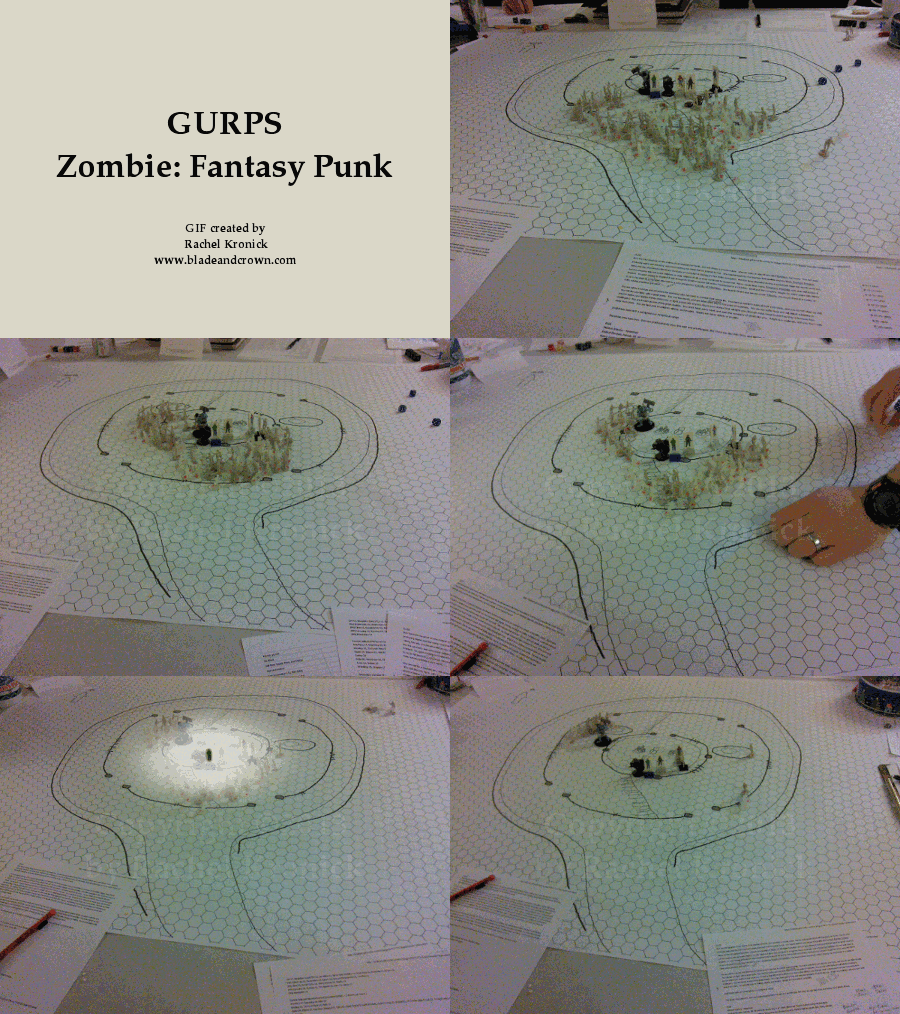
Oh, also: I realized after the first turn that the combat was going to progress as a wave of zombies crashing over us PCs. A lot of RPG combats could look pretty unintelligible to a bystander, but this game clearly moved in a fluid fashion from one round to the next. And I figured out that putting a series of photos together would make a pretty good movie:

GURPS Zombies Fantasy Punk animation

At the end, the paladin’s sudden surge of faith caused a vast number of zombies to go *poof*. I decided special effects were necessary here; it was a dramatic end to the game.

JonCon 2013, part I: Bootleggers’ Bible

Photo of Model T

Did we see one of these? Probably

This was run by the inimitable Bob. At the start, the players were just John and me. Bob ran this using a very light version of FATE; because the rules are so simple, and because all three of us are pretty familiar with the game, we created characters from scratch.

The setting: 1920s Cincinnati, when George Remus was the most prominent gangster. John’s character was a driver for Remus; mine was an enforcer. As I envisioned her, she looks like Chiyoko from the Akira manga.

The scenario was that one of our regular deliveries (“losses”) of hooch got held up by a rival gang, leading to an investigation, duplicity, negotiation and confrontation. It was quite fun. There were about three main factions involved, and it didn’t seem like Bob had a particular resolution in mind, which I like. In the end, we even found a non-violent way to wrap it all up. (Which I think took us all a little by surprise — everything seemed to be heading for a big battle at the distillery, but then a non-violent solution kind of snuck up on us.)

Bob’s GMing was great. He researched the period pretty thoroughly and dropped in a lot of atmospheric details: what a weird truck the Nash Quad was, Remus’ joviality, a Chicago mobster’s disapproval of Cincinnati Chili. Bob also brought out one of the best props I’ve ever seen in a game (which I won’t spoil here), and managed to pull off making Remus seem like a dangerous nice guy (a hard feat of characterization).

The game in general was lots of fun. A late addition player kind of hogged the spotlight, but it worked out anyway. We got to do a lot of nifty things, with good action scenes, opportunities for roleplaying, mysteries to investigate and ways to affect the story. All in all, a great opening to the weekend.

It also reminded of what a bizarre place the Twin Cities were in the Prohibition era, and of a Call of Cthulhu scenario I’ve run set in that era. Hmm… I’ll have to describe that scenario here sometime.