JonCon weekend

This weekend is the wonderful little gaming con known as JonCon. I’ll be there pretty much all three days, and so not posting much here. Hopefully I’ll have some great play reports to give on the other side of the weekend, though.

RPGs don’t die

Illustration of a heraldic sun

Not for a few billion years, at least

I wish people would stop referring to RPG lines as “dead”. (It’s not hard to find examples of this phenomenon.) RPGs don’t die; they just stop being supported. If an RPG has never been played by anyone, anywhere, but someone, somewhere is enjoying it somehow, then that game is still alive. And there are a lot of ways to enjoy an RPG — whether by playing games with it, or dreaming of playing it, or occasionally taking it down off a shelf and paging through it, or generating characters in it just for fun, or even putting it on a shelf and enjoying it as part of a collection. The only way for a game to be truly “dead” is for every copy to cease existing and every memory of it to be wiped. That doesn’t happen. Therefore, RPGs don’t ‘die’.

When people refer to a game as “dead”, I think they’re using that term as shorthand for “no longer being actively supported by the creators, and so no longer getting new official supplements for me to use in my campaign or read”. If so, I think it’s a very wrongheaded abbreviation for several reasons:

  • Your campaign doesn’t have to be supported by the publishers to continue. You can create material yourself. The publishers aren’t, and shouldn’t be, the only source of new ideas about a game. (A lot of people seem to have forgotten this, or perhaps they’re just busier.)
  • Even if you don’t create new material yourself, you can re-read things already published and have new ideas about them.
  • It seems to be an excuse for dumping on games that aren’t the New Hotness, which is a bad trend in all kinds of ways: it shortens people’s patience and attention span for enjoying older games; it’s a cheap way to seem cool by dumping on other people’s fun; and it discriminates against gamers who are poor and can’t keep buying new stuff all the time, for starters.
  • Using this kind of shorthand is damaging to the success of games, the motivation of authors and, well, the hobby as a whole; if someone keeps referring to something you’ve poured your energies into (whether as an author, player, GM, reader or whatever else) as “dead”, it will in some amount sap your interest in pursuing that game.

For all those reasons, I think referring to RPGs as “dead” when you actually mean “no longer being actively supported by the creators” is a really poor, and in fact damaging, choice of phrase.

So, hey — if you’ve referred to a game as “dead” in the past, please rethink that phrasing.

Item: a warhammer

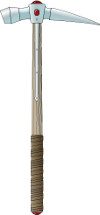
Illustration of warhammerThis warhammer is made from good materials (it is Quality +2), and has four deep red gems set into it. In a darkened place, you may notice that the gems have small glows inside them like nearly-cold embers.

Possibilities:

  1. In battle, the gems glow more brightly; once the weapon has tasted blood, the gems appear to burst into fire.
  2. When the warhammer is used in anger — that is, when you have an enemy named in one of your Traits and it brings you to strike at them, or when you are striking to fulfill a vengeful oath — it will strike especially hard, with a blunt damage factor of 14.
  3. If used to strike a door or other wooden structure, the warhammer will burst into flame and knock the structure into smithereens.
  4. What appear to be gems are actually rock crystal domes; the interior of the warhammer courses with blood. It pulses even faster when in battle.
  5. When properly invoked, each of the four gems can summon a fire elemental of significant potency. However, each elemental will seek to destroy the warhammer itself if given the chance.
  6. When the warhammer is held aloft and you make a proper speech, all troops on your side will be filled with camaraderie and determination to win in battle. In game terms, your side gains +2 in morale.
  7. When the warhammer intercepts another weapon in combat, both will erupt into fire and, if the opposing weapon is made of wood, it will catch on fire.
  8. When the bearer is grievously injured in combat, one of the gems will go pale and the bearer will suddenly feel refreshed. In game terms, this means when one of your characteristics is reduced to 0, one of the gems will go pale and the characteristic will be returned to its normal level. Once all four gems have gone pale, it will no longer work for you.
  9. The warhammer was forged in Chakotha, shortly before the Great Conflagration there. As such, the weapon was witness to the horrors that occurred. The gems were originally pale green, but as they saw more bloodshed, they grew redder and redder. The last owner was the last of the native defenders of Chakotha to fall. If you ask in the right language, the warhammer will convey the full horror of the Conflagration, and make clear to you that it wishes never to see war again; if allowed to not see combat for a full century, the gems will return to their pale green state. However, this is unlikely to happen, because the weapon is also highly effective in battle (Quality +4).
  10. The warhammer feeds on anger. Each time you use it to strike a target in anger, one of the gems will begin to glow brightly and you will slowly become an angrier person. In game terms, whatever your highest Trait is, it will shift (over a course of four stages, with intervening stages as decided by the GM) to become Angry.
  11. The warhammer can double as a smithing hammer, in which use it excels; the gems will soak in the heat of the smithing fire and allow you to smith far longer without returning the item to the fire, adding +2 to any smithing attempts.
  12. Whatever other effects it has, they are even stronger when the warhammer is carried by a woman at the time of the full moon.

Search for the Emperor’s Treasure play report

Hexagonal, modular version of Darlene map

Note to self: print, mount and cut out this board variant.

Lately, I’ve been thinking about Search for the Emperor’s Treasure, and last Saturday night, I played it with a few folks. I’ve been hankering for it since I looked into Gaming Hoopla, and since Matt mentioned wanting to play it. Saturday’s game turned out to be the deadliest session of SftET I’ve ever played.

One player’s character got killed by a bear in the little mountain village of Scrab. When he came back as a different character, that character got killed by a bear. In Scrab. Apparently, the villagers of Scrab are leaving too much trash around and are attracting bears. Or maybe the bears are just attracted to the bodies of dead adventurers left strewn around.

I’ve seen characters die in SftET before, but never twice for the same player! That was kind of amazing. At BGG, folks mention a rules variant where you can heal 2 points by doing nothing at a named location; that sounds like a good idea, and I will try it next time I play.

Also, we tried a rules variant I’ve been wanting to try: any time you end a turn in the same numbered location twice or more in a row, you must pay an item (Arms or Treasure) as a residence tax. This is to prevent players from going to (primarily) the Walled City and just camping there to collect treasure. I thought it’d keep people moving.

What actually happened was this: several of us kept losing items as we moved from place to place. Having to pay the tax made it hard to either meditate or heal, so things got kind of desperate. This may have been what made the game so deadly. We stopped the game after a few hours, not having found enough Imperial Treasures to end it. By the stop of play, some of us had lost multiple items to taxes (I’d lost two treasures, I believe!), and several of us were hanging on by a few hit points.

The session certainly didn’t dim my enthusiasm for the game, though it did convince me that this rule variant needs work. Perhaps the tax should only apply when you get treasure twice in a row in a single location? Or maybe I should just modify the encounter table so that there are no locations with more than one treasure result.

Small ways to introduce player narrative control

Illustration of an open doorwayIf your group is used to heavily railroaded, GM narration-centric games, it can be tricky to introduce player narrative control. If you’re the GM, you may not be ready to open the doors full-width to player’s getting control of what happens; and if you’re a player, you may not be in practice to take control. Especially with players, I’ve seen this happen; many are used to GM caveat being the rule, and may not ‘get’ how it should work for the players to take control, even in small amount. And it can be tricky, especially, for players to understand how much scope they’re being allowed.

In one of my groups, the players are all pretty used to storygames and other RPGs with lots of player narrative control. But in my other main group, a lot of the players come from a very traditional mode, and aren’t very used to taking narrative control themselves. So when I introduced narrative control to them, it seemed logical to me to try it in small steps.

It was a post-apocalyptic game, and they were searching through a survivalist’s burned-out bunker. They discovered and eventually accessed a safe in the floor. It had a bunch of things that weren’t very useful (computer drives, some gold) and a small box. “Inside the box is…” I said, “I don’t know. You tell me.”

This kind of threw them for a loop; this is where my suspicions were confirmed that they hadn’t had much experience with narrative control. After their eyes had gone back to normal size, they went into discussion mode — as this group does too often — and talked back and forth about what it should be. They discussed too much, it’s true (it took many minutes before they reached a decision), but they also came up with some very good ideas. And if I’d worried that they were going to go totally power mad, they completely didn’t. In fact, as they discussed things, they put far more of a damper on the possibilities than I ever would’ve; they vetoed each other’s suggestions as unrealistic or outlandish, even when I probably wouldn’t have. (This group tends to downplay their own abilities, sometimes to a frustrating degree.) In the end, I let the player whose character opened the box have final say. He decided it contained a remote key fob with several buttons, and decided not to say what it was a key fob to.

Not at all outlandish, even perhaps somewhat bland; but it fit with the milieu, it’s true, and the open-ended nature of the find (what was it a key for?) gave me, as GM, some good options and ideas as well. It finally turned out to be the keys to a speedboat that they needed for a fast getaway.

I tried this a few times over the course of the campaign, giving adventurous players the decision of what a bag contained, or what an NPC told them, or whatever else. I don’t think it taught them how to use narrative control perfectly — even now, players in that group tend not to think in terms of taking control of the narrative themselves, even when they’re playing games that explicitly allow it. I’ve had to remind them fairly often just how much they can use Traits for in Blade & Crown, for example. Maybe my GMing style has trained them to rely too much on GM caveat, or maybe they’re just used to GMs who habitually rebuff players’ suggestions. But I like to think that they’re a bit more open to player narrative control now, having seen some of the ways in which it can enhance the game. And it certainly enhanced that campaign.

If you’re considering small ways to begin introducing player narrative control, you could do worse than asking the players to decide what happens when they put on that ring, or what the weather is like today, or how the innkeeper reacts to their adventurous tales. It can be a good way to open the door to a wider universe of possibilities.

Adventure seed: Tenement Defense

This is a B&C adventure I’ve used a couple times with different groups as a one-shot, and it’s gone quite well. If you haven’t played in this adventure yet and might, you probably shouldn’t read below the divider!

long-sword_1f300

The PCs are all residents of a tenement in a medium-sized town. They’re all pretty low in SC. In addition, some or all of them are engaged in illegal pursuits. The tenement owner, Sardia, has taught a lot of them what they know. The tenement’s residents are quite close-knit, looking out for and helping each other, much like a family. Make sure everyone knows the other PCs’ names and abilities to reflect this. Begin the adventure by having the players describe one way in which their character has helped one of the other PCs, and one way in which they’ve been helped by one of the other PCs. If time allows, have the players describe how long they’ve been in the tenement, why Sardia decided to let them stay there, and perhaps some of their other history with the place.

Map of a section of AropashNext, ask what they’re doing on a typical day. Some of the players will inevitably describe being in a marketplace or on the street. Mention to them that, on the morning that the adventure begins, they see a rather heavily-armored woman who carries herself like a soldier: mercenary, knight or adventurer, they can’t be sure. (She may be heavily armed as well, though they can’t see well enough to be sure.) She is asking one of the merchants nearby if they’ve ever heard of a tenement in which dwell X and Y — X and Y being the names of two other residents of the tenement. This should pique the PCs interest, and they will proabably begin to follow or investigate the woman.

Given some work (Sneaking rolls, Streetwise, some good roleplaying, etc.), the PCs may discover some facts about the woman:

  • She’s not local — she has a slight accent, though they can’t tell exactly where she’s from.
  • She has a companion, a slight man with voluminous dark blue clothes.
  • They appear to be staying in a local inn of moderate repute and moderate (but not very high) quality. They’ve been staying there for a week or so.
  • A couple merchants whom they’ve interacted with will say that the woman appeared to be looking for a specific tenement, populated by people with the same names as the PCs. The woman refused to say why she was looking for the tenement, however.
  • If the PCs manage to get close enough, they may discover that the woman’s name is Chenin and the man’s name is Gorvol.

What’s going on

Chenin and Gorvol are adventurers. They’ve got a treasure map, and it contains clues that seem to point to a tenement in this town. They’ve already gone to one tenement and determined that it wasn’t the one they wanted. The PCs’ tenement is the next on their list.

Chenin is the brains of the outfit; Gorvol is adept in mystical skills (he knows Spirit Magic, Air Magic and Fire Magic to at least level 2, and knows several other magical skills), but he isn’t really guiding their little expedition. Chenin is the one who’s driven to find the treasure, and she’s the one interpreting the clues. She’s quite adept in social skills, while Gorvol isn’t. She’s also very good at fighting. She has Gorvol along because he’s good with a falchion and because she suspects the treasure may have mystical properties.

They’re interested in acquiring the treasure, first of all. They might be willing to talk to the PCs, though they are very wary of tipping off the residents to the existence of the treasure.

Chenin is not above hiring local thieves or assassins to break into the PCs’ tenement, if she thinks she can do it without alerting the residents. She has thought of trying to buy the tenement outright, but a) she is certain this will seem suspicious and probably show her hand, and b) she doesn’t have enough funds to do so anyway.

Directions for development

The PCs will hopefully try to gather more information about Chenin and Gorvol, and may even confront them about why exactly they’re looking for the tenement. Chenin and Gorvol will be cagey; they know better than to spill the beans. But Gorvol is not as sly as Chenin, and he might be conned into letting too much information go. They are both quite bloody-minded and willing to spill blood if it will mean them getting closer to the promised treasure.

If the PCs start asking for money to give Chenin and Gorvol access, they will become wary; the more the PCs ask for, the more desperate Chenin (and to a lesser extent Gorvol) will become. Even if the PCs seem to be making a genuine offer, Chenin will never believe them. Gorvol might be convinced, though he’ll find it impossible to convince Chenin as well. And if the PCs ask for larger sums, this will only cement in Chenin’s mind that their tenement is where the treasure is, and that she needs to act that much faster to get it before anyone else does.

If the PCs get Chenin’s map, they will see that several signs do seem to point to their tenement: the map describes a building near [landmark that their tenement is near], with stones that have ancient runes of [description that matches the builder’s marks of their cellar’s stones] in the cellar, etc.

As the PCs accelerate, so will Chenin and Gorvol, at least if the PCs allow them any way to find out about it. If the PCs get too wise to Chenin’s plans, she may try to kill them; if the PCs try to reinforce their tenement, Chenin may hire goons to help her; if the PCs appear to know that the treasure is in the cellar, Chenin will move up her plans to secure the treasure, probably by sneaking and breaking in under cover of night.

If the PCs don’t act fast enough, Chenin and Gorvol will still move to get the hoard. She will believe that it is in the cellar, which is accessible from the street. Remember that Chenin definitely has a plan that she will make progress on if the PCs don’t stop it.

Both times I’ve run this, it ended up with a fight involving the interlopers trying to get into the tenement and the tenement-dwellers trying to prevent them from getting in. Eventually, though, the PCs may end up victorious: they’ve defeated Chenin and Gorvol, and now they can find the treasure… right?

Denouement: The Treasure

So what, exactly, is the treasure? This can go a lot of different ways, and where GM judgment is especially called for. What happens from here will decide a lot of what the adventure ‘means’ for your group. I can see a lot of different possibilities, and I’ve run a couple of them now:

  1. There is indeed a vast treasure under the tenement. It requires some tricky maneuvering to get to (prying open some stone blocks, digging open a collapsed tunnel, etc.) but eventually the PCs discover a vast hoard. They are now rich beyond their wildest imaginings.
  2. There is a treasure below their tenement, but it is guarded by the ghost of an ancient warrior. The ghost must be killed before the treasure can be gotten — but how do you kill someone who’s already dead?
  3. There is no treasure in the cellar, but there is a tunnel that leads right into the middle of the local lord’s castle.
  4. As #3, but the tunnel leads into the local lord’s dungeon — the jail kind, not the adventuring kind.
  5. Sardia found the treasure long ago, and has already spent it all. In fact, she found the treasure when the tenement was owned by someone else… and used the money to buy the tenement.
  6. There are grave warnings in the tunnel: “Delve not here, lest ye home fall upon itself”. If the PCs go further in, they find the treasure, but their tenement quickly begins to squabble about who deserves what share, and eventually their little family falls apart.
  7. As #6, but it’s not the tenement that collapses; instead, the PCs’ newfound wealth attracts a horde of hangers-on and toadies, causing their town to become a hive of falsehood and flattery; and rumors of their wealth spread far and wide, causing foreign powers to start considering how to conquer the place.
  8. As #6, but the tenement literally collapses — into a giant hole in the ground.
  9. There is a tunnel entrance in the cellar, but the tunnel itself has collapsed. It will take a lot of people, or a lot of time, or magic, to excavate whatever is down there.
  10. There is no treasure in the cellar. It’s never been there, in fact — Chenin had the wrong house.
  11. There is no treasure in the cellar, but a closer inspection of the map (and application of Area Knowledge) shows that it must be in the cellar of the next tenement down the way.
  12. There is no treasure in the cellar, only the entrance to a vast cave network. But the cave matches rumors they’ve heard of a fantastic realm lying below the town…

If you run this as a one-shot and your players are okay with it, you can have the scenario result in very elaborate and expansive consequences. You can certainly ask the players what the consequences of finding vast wealth would be for their characters. And regardless of how you run this adventure, when you do, please let me know how it goes!

As may be obvious, this adventure is kind of a ‘dungeon delve in reverse’, where the PCs are not the ones doing the delving but the ones who must defend their home against intruders. It can be interesting to use this adventure to explore and contrast ways in which most dungeon delves are based on an assumption of amorality; it can also, perhaps paradoxically, just be a good one-shot with not a lot of consequences for the larger campaign.

I originally designed this adventure as a sort of prologue to Karna’s Cache, partially to see what the residents of such a tenement would do, but also just to see the situation from the other side.


Rules experiment: TGH minimum 1

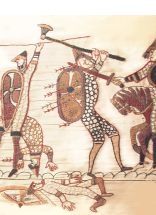
Combat from the Bayeux Tapestry

Ouch!

Toughness is a pretty important characteristic in B&C. It gets used lots of places. It’s hopefully not a ‘god characteristic’ (that is, the One Important Characteristic that must be had at all cost), but it can be pretty important to have at a high level if you’re going to be doing any fighting. And it can be especially tricky if you’ve got END 1, which therefore means TGH 0. In that situation, you’re going to automatically fail rolls to avoid collapse, for example, so anything that takes a characteristic to 0 or less will automatically knock you out.

When I wrote B&C, I considered this a lot. Is this too much of a death spiral for weak characters? It seems fair that someone who is significantly weaker than the ‘standard’ adventurer might need to be especially careful in combat. If you can’t take the heat, in other words, stay out of the kitchen, or at least wear something fireproof. That was my reasoning as B&C went into the market.

In my ongoing B&C campaign, however, there’s a mage whose END is 1 and who therefore has a TGH of 0. In practice, this has meant that he needs not just to be especially careful in combat, but to avoid combat altogether. Some of the players in this campaign have complained that it makes his character altogether too weak.

I still think it makes sense, really, that someone with TGH 0 should be so easy to take out. After all, knocking them out requires taking one of their characteristics to 0, which isn’t easy to do. It might make sense that someone with characteristics that low would be easily taken out.

But I think I’m going to try an experiment where the minimum TGH for PCs is 1. It should make everyone feel just that little bit more willing to be adventurous, and should hopefully lessen the death spiral a bit. I’ll let you know how the experiment goes — and if you try it, let me know, too!

The Erethane religion

This is an example religion for Blade & Crown, taken from my campaign world Calteir.

long-sword_1f300

Scattered in small communities throughout the Archipelago, including Sashtia and Morensia, there are people who practice the Erethane religion. The Erethanes believe that there are three basic principles in the world: the Dark, the Light and the Grey:

  • The Dark is the source of all things, the original progenitor of all that is, and the font of all primal potency.
  • The Light is the order-giver, the law-maker, the one who fosters growth.
  • The Grey is the delicate balance between the two, the repository of wisdom, and the primary source of humanity.

The Dark is symbolized by the Whirlpool (the great shape that appears in the night sky), which is the source of all things. The Light is symbolized by the Sun, which nourishes and guides all things. The Grey is symbolized by the Veil (Calteir’s main moon), which watches over all things and notes their passing.

One version of the Erethane holy symbol

One version of the Erethane holy symbol

Erethane holy symbols are three circles touching in the middle. Particularly elaborate symbols have silver for the Dark, gold for the Light and lapis lazuli for the Grey. The principles are personified as an inhumanly tall person wearing all white robes, including a veil over the face, but with a black sash; an impossibly tall person wearing all black, including a veil, but holding a lantern out of which hints of light can be seen; and a person of normal height holding a book.

The Erethane religion is heavily based on songs, many of which are quite elaborate. Important times in the Erethane religion are almost always accompanied by singing. Many people consider sound itself to be the means by which the Balance is achieved.

There are historical hints that the Erethanes were once followers of Karyath, but they are only hints. There are Erethane holy sites scattered throughout the Archipelago and older lands. Some are in quite dangerous locations now.

Game mechanics

  • Major restrictions: Do not forsake the Erethane life; do not be prideful or extreme in your ways.
  • Major requirements: Respect the Dark, the Light and the Grey; seek balance in your life; seek wisdom.
  • Minor restrictions: Don’t worship non-Erethane Powers.
  • Minor requirements: When you see the Whirlpool, sing the song of creation; when you see the Sun in the morning, sing the song of Law; when you see the Veil, sing the song of balance.
  • Times of reckoning: When the Veil shows her face (rare full moons); when the full Whirlpool is visible; eclipses; adulthood.
  • Rituals & intervention: Asking for forgiveness (through singing long songs); meditation (again, through singing); pilgrimage (to Erethane holy sites); miracles; oaths; blessings.
  • Conversion: Anyone may become an Erethane, although it takes a long time before an outsider will be treated as a full equal to lifelong Erethanes.

Major Powers

  • The Dark: Benevolence +1; Lawfulness +0; Influence -2. The source of everything.
  • The Light: Benevolence +0; Lawfulness +1; Influence -1. The bringer of life and order.
  • The Grey: Benevolence +1; Lawfulness +0; Influence +0. The Balance and source of wisdom.

Darklands art on eBay

Cover of the Darklands CRPGIf I had $2000 lying around, I’d be buying this right now: the original cover art for Darklands, one of the best CRPGs ever. The thumbnail to the right shows the cover as it was published; what’s on sale is the original painting that the cover was based on. Somewhat problematic depictions, yes, but still, very evocative, and an important piece of history.

Gaming Hoopla

Something I forgot to note in my slew of Con of the North posts: a couple weeks from now (April 19-21), there will be a pretty nifty gaming convention in Wisconsin called Gaming Hoopla. They now have their event listing up, and it looks like there are quite a few interesting games scheduled. Not a lot of RPGs, but a good number.

Rokko the Dwarf from Search for the Emperor's TreasureFor me, the biggest draw is one of their guests: Tom Wham. He’ll be running a bunch of games there. I’ve never been one for pro-worship, but he’s definitely a game creator I’d like to meet. Search for the Emperor’s Treasure has always been one of my favorite pseudo-RPGs, and I like most of his slew of boardgames, with their funny, silly attitude that mask deep mechanics. I’d love to play games with him, and perhaps ask how negotiation is supposed to work in SftET.

Real life won’t permit me to attend, but if you go, I’d love to hear a report!