Quick and easy healing rules for Blade & Crown

Image of a bandaged statue lying on its sideI don’t think I’ve ever met a healing system that I like. My ideal healing rules would need to perfectly balance a bunch of factors:

  • Player agency: The rules can’t make it feel like your healing is completely out of your hands.
  • Healer agency: At the same time, the skill and care of the person helping you recover should matter for something; a PC healer shouldn’t just feel like a machine that vends restoration.
  • Speed: Wounds should heal faster than they do in the real world, so that major damage doesn’t become effectively permanent.
  • Slowness: Wounds shouldn’t heal so quickly that players rush into combat without a care for consequences.
  • Detail: Enough to keep it from feeling like a generic bucket of “hit points”.
  • Ease of tracking: To make sure healing doesn’t feel like accounting.
  • Simplicity of system: The healing system should also work basically the same as the rest of the game, without needlessly adding mechanics.

That makes it hard to come up with a really good set of healing rules. The rules in B&C are okay, but I’ve never been especially enamored of them — they’re the sub-system I’d most likely change if I brought out a second edition.

But that’s what blogs are for! Here’s a simplified healing system that I’ve been toying with:

Once per week, you heal a total number of points equal to 1 + the Physician skill of whomever is attending you.

That’s basically it! Some specific considerations:

  • If the physician has skill 1, you (the person being healed) decide where to allocate the healed points. If the physician has skill 2 or more, they decide.
  • Following the Rule of Four, a physician can attend up to 4 patients with no penalty, up to 16 at an effective skill level of 1 less, etc.
  • You can substitute Herblore skill for Physician; Herblore functions here as Physician skill of 1 less.

There’s no die rolling involved here, and for some players, that might mean a loss of agency. (Some people want to roll dice every chance they get, even if it means potential harm to their character!) But hopefully that’s balanced by the choice of where to allocate the points.

If you want a grittier system, make it “per month” instead.

As always, I’m interested to hear how this works if you put it into play!

Edit: After trying this a bit in play, I realized that this rule over-exaggerates the importance of Physician skill. I’ve written up some further thoughts about quick and easy healing rules for B&C.

Snippets from Calteir: Morensian mercenary traditions

Illustration of warhammerIn Morensia, mercenaries are fairly common. In fact, it is arguable that Morensia was founded by mercenaries. Many large towns will have hundreds of mercenaries headquartered in them, usually in several large or many small companies.

Since the reign of Thardan IV, mercenaries are required to register with the overarching Mercenaries’ Guild. Also, by considerably more ancient tradition, mercenaries in Morensia are required to keep headquarters in one or another town. This has the political effect of preventing them from being completely mobile, and thus of giving them a vested interest in maintaining at least a modicum of loyalty to the local lord. This makes Morensian mercenaries less likely to be trouble-makers rampaging through the countryside and deposing lords when they see fit.

It is quite common that a company of mercenaries has multiple squads or troops out escorting caravans, pilgrims or even low-level lords. In fact, most mercenary headquarters are inadequate to host all their constituent mercenaries at the same time.

Another effect of mercenaries having headquarters is that potential clients often judge them by their buildings. “Oh, this company has a stone palisade!” “Ooh, this one has a stone palisade and a stone tower!” That sort of thing. A small, shoddy mercenary headquarters building is usually considered a sign of a small, poorly trained rabble.

Mercenaries usually recruit in the spring, around the time of the Flower-Dance. It is common for mercenaries to sponsor recruitment fairs, at which all legal comers are allowed to prove their mettle in archery contests, tests of agility, etc. Mercenaries usually band together to do common fairs, to avoid overlap and to spread out expense. Because of the timing of these fairs, “First of the Flower-Dance” is a common way of saying that someone is tops, the pick of the crop, the elite of the bunch.

Categories: Armies, Mercenaries, Professions

Fictional nonfiction 2: The Dune Encyclopedia

Snippets of poetry from the Imperium; a sample folk tale from the Oral History; brief biographies of over a dozen Duncan Idahos; two differing approaches to Paul Muad’Dib himself and to his son, Leto II; Fremen recipes; Fremen history; secrets of the Bene Gesserit; the songs of Gurney Halleck — these are just some of the treasures found when an earthmover fell into the God Emperor’s no-room at Dar-es-Balat, and are now included in The Dune Encyclopedia.

So begins one of my favorite examples of fictional nonfiction: The Dune Encyclopedia.

Dune Encyclopedia coverWhen I discovered this book in the high school library, I proceeded to serially check it out for months. I think I ended up checking it out for a full year, or close anyway. It’s well-presented, as a thorough encyclopedia with articles about history, linguistics, monetary policy, music and much more. Pretty much every named entity in Herbert’s books, as of 1983, is described in detail — often considerably more than was available anywhere else in 1983 (and, thus, often with a great deal more embroidery than Herbert himself had done). Articles include plenty of “see also”, making the whole thing like a wonderful expository choose-your-own-adventure work.

The Encyclopedia never had much official status in the Dune canon, I think. The official website for the new novels by Brian Herbert and Kevin J. Anderson stated:

THE DUNE ENCYCLOPEDIA reflects an alternate “DUNE universe” which did not necessarily represent the “canon” created by Frank Herbert. Frank Herbert’s son, Brian Herbert, writing with Kevin J. Anderson, IS continuing to establish the canon of the DUNE universe. This is being done with the full approval of the owner of the DUNE copyright, the Herbert Limited Partnership.

I don’t think its canonicity was ever particularly strong to begin with, though; after all, Herbert himself said in the foreword,

As the first “Dune fan,” I give this encyclopedia my delighted approval, although I hold my own counsel on some of the issues still to be explored as the Chronicles unfold.

Still (or perhaps because of this), it’s a pretty amazing work: 525 pages, hundreds of articles, vast amounts of speculation and filling-in of the details of Frank Herbert’s Dune universe. There’s a tantalizing in-world bibliography at the end, listing such works as Memoirs of a Sietch Woman, A History of the Fremen Language, “Recombinant Research in the Tleilax Tradition” and Pre-Guild Stories for Children. The almost hidden list of authors at the very end — I’d never actually noticed it until now — includes 40-odd names, implying that it was a large project; Dr. McNelly was truly the compiler, not the sole author.

Dune Encyclopedia: illustration of a harvester, by Matt HowarthThe Encyclopedia has also got some superb illustrations by Matt Howarth and other artists. Interestingly (and frustratingly), it’s hard to tell who exactly the other illustrators are; while Howarth signed his full name to his work, all the other illustrations are signed either with just “Walters”, an unreadable cursive name, or nothing at all. I can find no list of artists in the book.

Part of what makes it hard to tell who’s responsible for what is that the book was written pretty thoroughly from an in-world perspective. The Introduction, quoted at the beginning of this article, is credited to one Hadi Benotto, writing in 15540 AG. The article on the Rakis Finds is kind of amazing; it describes the finding of the God Emperor’s no-room, containing vast amounts of books (on Ridulian crystals), and the great amount of information suddenly accessible within, leading to the creation of the Encyclopedia itself. The in-world origin of the Encyclopedia reminds me of the ‘story’ of Borges’ “Tlön, Uqbar, Orbis Tertius”; the layout of the Imperial library reminds me of Borges’ “Library of Babel”. Both very apposite allusions.

It’s interesting how that in-world perspective changes the feel of the work. It adds a whole layer of flavor to the worldbuilding. Rather than getting an objective stance on Dune, we’re seeing it through the eyes of people who are, themselves, trying to interpret events long after the history itself. (Remember that the events of Dune supposedly happen in about 10191 AG, or about 5000 years before the Encyclopedia is written.) We don’t get the objective truth on all the mysteries of Paul’s life, or Paul II’s life; instead, we get people long after the fact speculating based on their own limited information at hand. So the mysteries feel all that much more mysterious.

It also does a lot to increase immersion. Lacking that artificially objective vantage point, it helps us see the information presented from an in-world perspective. The concerns of the Dune universe aren’t presented at a remove; for the authors of the Encyclopedia, they’re real, pressing, interesting concerns. In an interesting way, the fictional author’s concern with the material helps make it all the more compelling.

All in all, a thoroughly fascinating piece of fictional nonfiction — perhaps one of the best.

The Dune Encyclopedia is periodically available on Amazon or Abe for nearly-reasonable amounts. Or maybe you can just check it out from the high school library for a few months.

Another long delay since the last post; it’s been another extraordinarily busy week.

New Traits for Blade & Crown: Short

Traits don’t always have to be personality-based:

Divider illustration of a sword

You are Short. People may also take you less seriously for your diminutive stature, and you may have trouble reaching hand-holds when climbing, or striding across wide gaps. Yet you are also able to fit in spaces that others would not, your abilities may be underestimated by others, and you might avoid that trap set to slice at the heads of your taller companions.

Your Size will be in the range of (2 × your Short rating) lower than it would otherwise be. It may be slightly higher or lower, depending on how densely muscled you are.

Snippets from Calteir: Coins of Aros

Photo of coins sitting in and next to a metal cupThe ancient and possibly mythical hero Aros did many wonderful deeds in the Kreshar region of Morensia. Among these, he gave his last coin to a poor woman in the village of Arosart. When she bought a loaf of bread with the coin and returned home, she found that the coin had returned to her purse. She continued spending the coin and every time, it returned. Even better, when the people of the village spent the coins she had given them, those coins, too, returned to their purses.

At present, no one knows where the Coins are. There are stories that the Coins are buried somewhere in the hills near Arosart (which have become fairly well-pocked with the pits of treasure hunters over the years). Other tales say that the Coins gradually disappeared, until only the last one remained in the hands of the widow, who returned it to Aros. As he walked out of the village, the Coin dropped out of his purse and was lost. Occasional treasure-seekers come to the village looking for the fabled Coins, but none have ever found them. The villagers like to say that the ghosts of the Mountain People jealously guard the Coin’s (Coins’?) resting place.

A more likely explanation is that the Coins were a metaphor for the nearby mines. The village found silver in the hills, and gradually became richer from the silver, until eventually the vein was tapped out and the village was left contentedly prosperous. Well, anything’s possible.

Categories: Magic, Treasure

Why I don’t want you to tell me about your character

So have I told you about my favorite Champions character? Well, third favorite actually, after The Human Cheese Grater and Bituminous Man, but he’s really my favorite in some ways because of the awesome time I, um, the time where it, where he, because there was a time that he was so awesome — oh, wait, I forgot to tell you his name. But first I should tell you about his costume, which is totally the most awesome thing you will hear about today because…

Have you ever been subjected to someone else telling you about their RPG character? I have, and it can be a pretty unpleasant experience. In fact, I’ve found it to sometimes be a downright awful experience, and this feeling seems to be widespread among gamers. However, I find it totally fascinating to look at the reasons why we don’t want to hear about other people’s characters.

A couple years ago at Minicon 47, I was on a panel with Sherry Merriam and some other folks where we talked about just this topic. I feel like I learned a lot from the panel; having Sherry, a trained counselor who’s also a gamer, helped a lot! What follows is a mix of ideas from that panel and more recent insights I’ve had.

Why is it so annoying to be subjected to stories of someone else’s characters? The foremost cause for me is the way that RPGs work. When we game, we’re creating a story while we’re in the moment. The story is all about what’s going on as we’re playing. In the moment, it’s hugely entertaining; later on, memory may fade, and intensity may wane. And, importantly, the audience for the game is the people playing. It’s a story expressly designed to entertain one group of people. And even within a group, people are going to be interested in different aspects of play at different times, so it’s not even accurate to say that everyone within your group will share your interest in your character’s exploits.

No wonder, then, that people outside that group — without all the context and personal involvement — would be far less entertained that those who were in it. RPGs are, right off the bat, almost designed to be hard to recount to others later on; what’s happening in the moment is for the enjoyment of the people who are there, in the moment. Later recounting is going to lose a lot, and reading someone’s post-facto account of a harrowing adventure is rarely as enthralling as firsthand experience. It’s like watching a TV show about restaurant food: no matter how carefully the presenter chooses their adjectives, it’s not going to convey the actual sensation of eating.

This makes an interesting contrast with electronic gaming, which suffers from (what seems to me) almost the opposite problem: with games like Skyrim or GTA, other people share almost too much context. Yes, you retrieved Dawnbreaker after an epic fight. So did I. So, for that matter, did nearly everyone who’s played the game. This illustrates an important thing about stories: they need to be familiar enough to relate to, but not so familiar that the listener already knows the story before you open your mouth. Stories have to be understandable without already being a known quantity; there’s a particular range of familiarity within which a story will be interesting to a bystander.

So I was telling you about his costume colors, which I’ve been trying to rework lately. Here, let me see if I’ve got my latest sketch. This’ll just take a minute, because my tablet has been taking a while to boot up lately. You probably noticed that my tablet is blue, which is my favorite color, but his costume only has a little bit of blue, because — ah, okay, it’s booted up now, so where was that sketch…

All this is compounded by some geeky tendencies. One useful definition of ‘geek’ is “someone who is willing to indulge and talk about their interests even when doing so is against social protocol”. To the extent that this definition is true, it’s only natural that a geeky person would want to talk about their character even when doing so generates some awkwardness.

Another common side of geekiness, one explained in the Geek Social Fallacies, is the misconception that others will necessarily share all your interests if they share any of your interests. So if someone else likes RPGs at all, of course they want to hear about the early career of your 16th level Elven hamdinger, right?

As we put it on that panel a couple years ago, telling someone about your character is a lot like oversharing about your baby. You might be highly proud of your baby’s new teeth, or ability to walk, or whatever, and you might want to gush about their accomplishments, even to people who are completely uninterested. You’re proud, and you can’t understand why everyone else doesn’t immediately care how astounding, clever, entertaining and downright important your PC’s accomplishments are. Yes, some people will be interested, but hardly all. “Sorry, all PCs look like Winston Churchill to me.”

The tricky thing to understand is that your baby is important, but that doesn’t mean they’re unique. It also doesn’t mean that what’s important to you will be important to everyone else; not everyone will be interested in hearing your baby’s exploits, even if that includes besting Snarg the Indomitable with nothing but a sippy cup.

His costume is totally awesome. I asked all my friends and they agreed. Totally. Awesome. You agree, right? Because I actually spent 27 — no, sorry, I forgot, 29 — points on buying the costume. It was a perk for his Caped Avenger tree, which I know you said you don’t understand because you’ve never played this system, but I’ll come back to that. Hey, have I told you his name yet? Anyway, I forgot two of the points because our GM never lets us…

There’s a third factor that makes “let me tell you about my character” so bad, I think. That is simply that a lot of gamers — just like a lot of humans — aren’t especially good at telling stories. My pullquotes in this article aren’t direct quotes, but they’re heavily inspired by an actual experience I had. Hearing that I’m into RPGs, someone at a con once started subjecting me to uncomfortably bad stories about his superhero characters. It almost could’ve been interesting, but he did it in a horribly bland, mechanical, rambling way. He didn’t really think about what he was going to say; it felt more like someone reading the phone book — and doing a bad job of it — than of someone recounting heroic legends. I think some of what he was saying almost had some intrinsic merit as an interesting story, but he killed it through a host of storytelling errors: focusing on mechanics, even though I’d said I wasn’t familiar with the system; destroying dramatic tension when he should be building it up; generally rambling; repeating himself; not listening to or caring about what his audience was interested in; and other problems. (That last I think blurs back into geek social fallacy problems. He assumed I would be interested, regardless of how horrible his storytelling was; he also treated me as an object to talk at, rather than a person to talk with.) That is not to say that all gamers need to be good storytellers, but if you’re going to subject me to stories about your character, doing it in a clumsy way isn’t going to help.

Is it possible for someone telling me about their character to be a good experience, if they’re a better raconteur? Yes, but they’ll have to be very good. I think the aspect of RPGs that they’re for the people playing, while they’re playing, means that RPG tales start off at a disadvantage compared to, say, prose fiction. Prose fiction is designed for the reader to digest at their own pace, usually far removed from the author. Yet the author has all the advantages that prose fiction brings: the ability to put a story aside for a day or an hour and come back to it, with narrative continued from just where it left off; the ability to use long, complex sentences that sound awkward in colloquial speech; and the ability to rework and edit the language until it conveys a narrative smoothly and effectively. Oral storytelling, too, is a skill that people can learn, but not many practice it. And being able to create a story with a group of fellow gamers does not automatically confer the ability to relate that story to someone else.

A lot of SF&F authors seem to have gotten their start writing up their RPG campaigns. And there are some great raconteurs in the RPG community. It’s definitely possible to make your character’s tales interesting and worthwhile to others. That just takes good storytelling skills, which include sympathy with your audience, deftness with language, and an understanding that neither of the previous skills comes automatically with being a gamer.

So you know what? It’s entirely possible that I do want to hear about your character, so long as it’s a story worth listening to, and one well told.

Hm, what? Yes, I was going to get to his — why the cape is only a little blue. Yes, I need to go, too. Actually, I think I left my mayonnaise out. But I’ll explain about the cape first, because trust me this is the best part yet…

Check out the current Bundle of Holding

Bundle of Holding masthead imageThe Bundle of Holding, which I’ve been privileged to be part of, is currently featuring a bunch of very cool indie games: Torchbearer, Uresia the Grave of Heaven, Nobilis, Lords of Gossamer and Shadow (think: Amber Diceless 2nd edition) and more. Very cool stuff — a steal at US$9.95 for the core three books, and well worth the ~US$20 to get the full package. Go check it out!

Blade & Crown dice probabilities

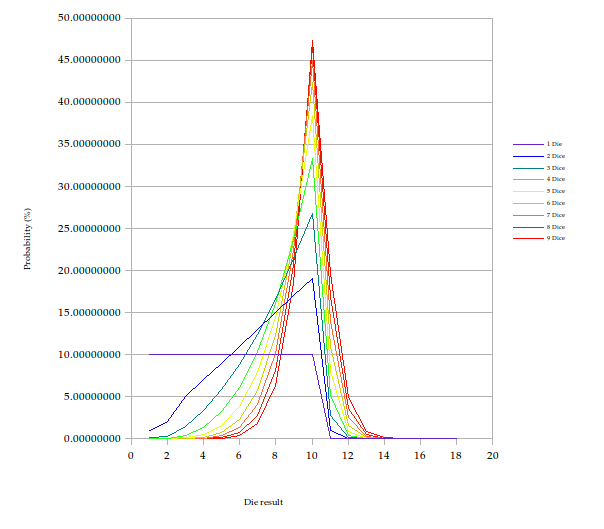
As part of designing Blade & Crown, I was naturally curious how the dice mechanic works. Do large numbers of dice make characters succeed all the time? What’s the difference between rolling one die and rolling three? With the help of my friend Matt, I worked up some very useful charts detailing the dice probabilities for Blade & Crown. Pre-press versions of Blade & Crown included this information in an appendix.

I decided to remove them from the version I actually published — seemed a like a bit too much to include in the actual book. But some folks reading this might be curious what the dice probabilities for the dice in Blade & Crown are. Here, then, are those charts.

First is the chance of getting a given number, based on the number of dice:

Chance of getting any particular number in Blade & Crown, based on number of dice rolled

Sorry the type is so tiny — that’s as readable as I could make it while still fitting. Here’s the same information as a graph:

Percentage of rolls meeting a specific target

This chart shows the percent chance of succeeding against any particular number:

Chance of success per target number

Interesting, albeit crunchy!

Con of the North 2015: House of Indie Games’ games

I participate in the House of Indie Games track at Con of the North. We’re mostly just a bunch of friends who like indie games. Two of us have even published our own indie games (Blade & Crown and Heirs to the Lost World). Most years recently we’ve put together a pretty cool lineup of games, and 2015 is no exception:

  • Friday 12-14 The Condor’s Fall
  • Friday 14-18 Strange Stars
  • Friday 18-22 Crisis simulation
  • Friday 22-24 The Quiet Year
  • Saturday 10-14 Caravan on the High Plateau
  • Saturday 14-18 The Dooms that Came to Chaegrae
  • Saturday 18-22 Classified
  • Sunday 14-18 Microscope
  • Sunday 18-22 Into Glorantha

Here are the descriptions, to further entice you:

The Condor’s Fall

You came to Spain with the Abraham Lincoln Brigade to fight fascism and to support the Spanish Republic. You and your comrades are in a remote village, without the arms to defend it or bring the fight to the enemy. Hitler’s dreaded Condor Legion draws near. Then an opportunity presents itself to even the odds.

p. 25 of the events book

John always runs a good game, and I love the politics implicit in this one.

Strange Stars

Explore a new setting for Fate Core and Stars Without Number: Trey Causey’s “Strange Stars” RPG setting, a pulp and comics inspired game set in the far far future. Take some original Trek and mix liberally with Farscape, Traveller, and Transhuman SF in this anything goes space opera setting. I’m running it using Fate Core, because, well… I wrote the Fate Core conversion for the game!

p. 29

This one also sounds great. John’s own blog entry for this points to Trey’s extensive index for the game.

Embassy Crisis Simulation

Benghazi! Well, no – you’re supposed to do better. Each player has an embassy role – Ambassador, deputy, Security Officer, and intel chief. The group has collective goals: preservation of American life and property; and individual goals. The Embassy is in the fictional country of Erewhon; characters are pre-rolled. No specific rules are used; the GM is a retired US diplomat.

p. 35

Alan ran one of these for us a while ago and it was really cool. No dice, not even rules really; just a straight-up governmental war game, much like they use in the State Department.

The Quiet Year

The Quiet Year is a map game. You define the struggles of a post-apocalyptic community, and attempt to build something good within their quiet year. Every decision and every action is set against a backdrop of dwindling time and rising concern. The game is played using a deck of cards – each of the 52 cards corresponds to a week during the quiet year. Each card triggers certain events – bringing bad news, good omens, project delays and sudden changes in luck. At the end of the quiet year, the Frost Shepherds will come, ending the game.

p. 42

The Thursday night group has had a lot of fun with The Quiet Year these couple… years. It’s become one of our standard one-shot games.

There was a little confusion in the description for Bob’s game, because the Con has it listed as a board game. It’s really not! The Quiet Year is a collaborative storytelling game that involves a map. Not a board game, at least not in any traditional way.

Caravan on the High Plateau

Entangled in a war against the Spanish in their so-called New Crusade, Moctezuma, the Great Speaker of the Aztec Empire, has ordered a dozen cannon from the pirates of Port Royal. As the pochteca caravan makes its way across the high plateau, it encounters a Spanish patrol, but that is the least of its worries. Heirs to the Lost World is a swashbuckling RPG set in an alternate history 1665.

p. 50

I’ve said this before, but the stunting mechanic in Heirs is probably the best I’ve ever seen. It does a fantastic job of encouraging players to come up with exciting action sequences.

The Dooms that Came to Chaegrae

The Tomb of Gemenos has loomed over the middle of Chaegrae for generations. All who have dared to enter, or even to approach too closely, have had horrible fates. But now, you and your motley friends have come to plumb the depths of the tomb. You are unafraid of the Tomb’s strange fates, because you already know how you will die. The Tomb is but the next step in your destiny.

p. 59

As I mused before, this is going to be an experiment in high-powered Blade & Crown, where your Traits allow pretty dramatic effects. Let’s see who has the stronger doom, Gemenos or you!

Classified: Covert Roleplaying

Play a 1960’s Secret Agent in this Cinematic retro-clone RPG, where gambling, car chases, gadgets and gunplay are the keys to defeating the evil mastermind. Think 007, Derek Flint, Matt Helm, Napoleon Solo, Modesty Blaise – ok, even Austin Powers.

p. 66

The system is heavily modeled on the James Bond 007 game from West End. I think it actually qualifies as a retro-clone. Alan’s games of 007 have produced some of my most memorable moments ever from gaming. Of course he’s also a retired State Department official, so he may have to stay away from things that are actually Classified…

Microscope

Together we will tell a saga. The rise and fall of a forgotten empire; the spread of humanity across the stars; the course of the War for AI Liberation — we’ll decide what history to make together. Starting in the broadest scales and then zooming in to decisive moments, we’ll weave a fascinating tapestry together. Play Microscope and make history!

p. 82

This is the other frequent one-shot game for the Thursday night group. You can read some of our Microscope histories here on this blog.

Into Glorantha

With the release of the massive Guides to Glorantha, it is a great time to explore one of gaming’s earliest and richest fantasy worlds. Whether you are a newbie or a veteran come form a Hero Band and take part in an epic adventure at the end of your con! For more info on Glorantha visit glorantha.com.

p. 86

I’ve never played HeroQuest, but its design is pretty influential, and as I said above, John always runs a good game, so I’m looking forward to this.

Divider illustration of a sword

All in all, quite a line-up! I hope to see you there.

Con of the North 2015 program book is here!

A couple days ago, the Con of the North 2015 program book came in the mail. And it is very big. Here’s the 2015 book, with the 2014 book for comparison:

The Con of the North 2015 program book, with the 2014 book for comparison

The new program book is letter size, with glossy pages, nice maps and some actually pretty informative ads.

More importantly, the Con looks jam-packed with cool gaming. I’m already starting to ponder what games to register for, and I’ve already had a few “Noooo! Too many good games in the same time-slot!” moments. It promises to be a great con.