Busy, busy, busy

With vacation time comes the chance to get more work done. Such is life for the non-full time game designer.

Over the past week or so, I’ve been working on a bunch of different projects:

    Small section of an adventure map

  • The Bandit Map. This continues to be very close to publication. I really only need to do some final edits, but as always, those are some of the hardest things to do.
  • Scheduling the RPGnet IRC chat.
  • The sooper-sekrit dealio. This is a very big, possibly unprecedented, project. It involves a bunch of different steps and sub-projects; the whole thing has been occupying a lot of my waking hours, and some of my sleeping ones. I’ve been working furiously on it the past few days. It’s pretty amazing. I hope to have solid details to reveal about this project during the IRC chat on the 8th.
  • Lots of little projects, household repairs, communications and other business.

So it’s been a very busy couple of weeks.

I’m actually going to take a vacation from the vacation work over the next week or so. So no updates until probably the week before Convergence.

RPGNet Q&A, July 8

CorrespondenceWorth noting: I’ve arranged with Dan Davenport to do an IRC-based Q&A. It’ll be on July 8, from 7 to 9 pm CDT. I’ll post a reminder when it’s closer to the arranged time.

To get into the chat, you can connect to the irc.magicstar.net server with your favorite IRC program, in the #rpgnet channel, or use the handy-dandy web interface.

I actually did an impromptu chat session a couple days ago, having been asked by Dan to run a test to make sure I could connect to the channel. My IRC skills are not what they once were, but still, it all went pretty well. I’m looking forward to July 8.

Super-legality for PCs

Here are some common campaign styles for RPGs:

  • The PCs live as ‘space assholes’ or ‘murderhobos’, wandering in search of fame and fortune. They are either able to skirt the law, or stay just ahead of it.
  • The PCs work as police officers, superheroes or members of the Star League Patrol, making them enforcers of the social order.
  • The PCs explore the frontiers, making their way beyond the bounds of normal civilization and mores.
  • The PCs skulk about in the shadowy realms, as thieves, agents or ghosts, delving into the dark secrets normal society doesn’t know, or doesn’t want to know.

Image of prison gate, openI think this describes the vast majority of games I’ve seen. Notice anything these campaigns all have in common?

It seems to me that a lot of games — probably a majority of them — assume some sort of super-legal, extra-societal status for PCs. In many games, the PCs stand outside the social order — perhaps immune to it, or just ignorant of it. Fiasco comes to mind here, where the characters are assumed to be willing to do horrible things to get what they want, and to then suffer horribly for it. In other games, the PCs may be part of the social order, but they are then usually the ones who help mold and enforce that order. Indeed, games like Dogs in the Vineyard make this completely explicit. (Quis custodiet ipsos custodes? The players do, and that’s all there is to it.) Whatever their position, they are not subservient to the social order.

Am I just arguing that RPGs are a power fantasy? I suppose that’s part of it. But it’s a very particular kind of power fantasy, and I find that interesting.

How many games are there where the PCs are not somehow immune to the social order? It feels like InSpectres gets close. In it, the PCs are assumed to be fairly menial workers in a ghost-busting franchise, neither movers nor shakers in the world. The PCs have some slightly exceptional abilities, but are generally schlubs like anyone else. But it’s not clear how immune the PCs are to the rules of normality, and the one time I’ve played it so far, I would say that tension — how legal/normal do we need to be? — was one of the biggest tensions in the game. Related to InSpectres, the Ghostbusters RPG plays with some of these conventions; the PCs can easily be everyday schlubs who are prone to being arrested for carrying around unlicensed proton accelerators or leaving slime all around. But both these games are comedic; characters’ ability to amuse the players gives them some form of immunity from societal consequences that we real humans don’t enjoy. So even though the games embrace mundanity, the characters still enjoy a form of extra-societal status.

Some games allow the PCs to become mired in social obligations. HârnManor seems one of these. The most common criticism I’ve heard of it is “Who wants to calculate taxes in an RPG?” And that’s a fairly accurate charge, because the supplement really does try to treat all aspects of medieval landholding in a rigorously realistic way, right down to paying taxes. I think that the system encourages characters to go do adventurous things, however, through the obligations imposed on them: if the northern fields are only producing a 44% harvest and that means the peasants are going to starve, then the PCs had better go figure out what’s causing the problem. And the system presumes the PCs will be pretty much at the peak of the local social order, so they’re still deciding the law more than they are subject to it. From what I understand, games like BirthRight do the same thing, enmeshing the PCs in social obligations but simultaneously giving them power to change the world. Heck, I think Braunsteins might fall into this category.

Are there other games where the PCs operate entirely within the social order? There are certainly lots of games where the PCs are not the most powerful entities in the world; really, most games probably fit that description. But I don’t think that’s a sufficiently rigorous definition here. Even when the PCs are relatively mundane, or relatively powerless — think, for example, of Call of Cthulhu — the PCs are still the ones with the power to avert disaster, or to go beyond the bounds of convention.

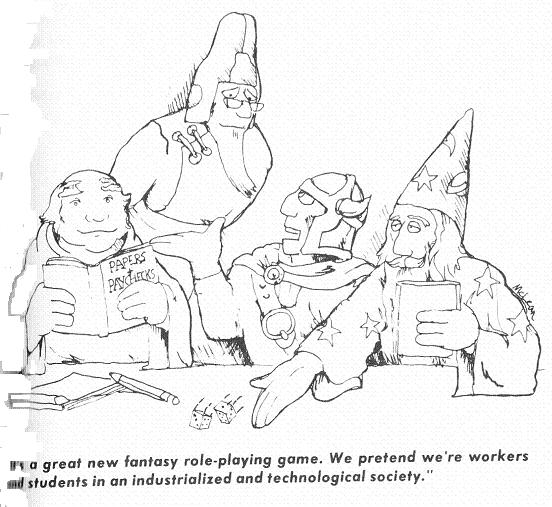
Are there games where the PCs truly live entirely within the bounds of ‘normal’ human society? The classic cartoon by Will McLean in the 1st edition Dungeon Master’s Guide alludes to this:

It’s a great new fantasy role-playing game. We pretend we’re workers and students in an industrialized and technological society.

Maybe that kind of game would appeal to wizards, clerics and fighters in a typical D&D world, but does it appeal to any of us in the real world? And does it mean that RPGs necessarily include a super-legal element?

Surprise as a stance?

Illustration of a warhammerIn Blade & Crown, combat stances are pretty important — so much so that I think they’re nearly essential.

In fact, I think their use could be extended. One additional use is in surprise situations. As I stated in the rules, when you’re surprised, your defense roll is automatically a 1.

Here’s my suggestion: instead of surprise causing an automatic defense roll of 1, let surprised characters roll defense. (Probably using PER instead of the usual characteristic.) But they must declare a Surprised stance, which causes a -8 modifier to their defense roll.

This way, when you’re surprised, you’ll still usually end up with a defense roll of 1 (since that’s the lowest a roll can get). But you might occasionally be able to get a 2, 3, 4 or even higher, and you can pull in Traits to perhaps increase your roll.

It also seems logical that you’d get a -8 modifier to attacks when surprised, and probably a -8 modifier for maneuver as well.

This method means more rolling, but it also means that surprise isn’t quite so inevitably deadly. I haven’t had a chance yet to experiment with this way of handling surprise, so if you try it, let me know!

Blade & Crown Open Thread 1: How are you using it?

Blade & Crown Open ThreadAfter some discussion last month, I realized that there’s no designated place on this blog to discuss Blade & Crown. So, with no further ado, here’s an open thread to do just that.

And here’s a discussion topic to start things off: What are you doing with Blade & Crown? Are you running games? Playing in a game? Planning something? What setting(s) are you using with it? Are you reading it? Using it for inspiration? I’d love to hear your answers!

WisCon 38, part 3: Wrap-up

Other general things WisCon 38 has me thinking about:

As always, WisCon this year had a lot of powerful, important discussions. The discussion about social isolation was, for me, the one most directly related to gaming. But an ongoing, overall discussion, about who gets to be in our fandoms — and who gets to decide that — is an extremely important one. As I mentioned in the last post, Nora K. Jemisin’s Guest of Honor speech on this topic was really powerful. There has also been a lot of discussion about how we handle it when creeps find their way into our fandom. And general discussion about “inclusion”, and who gets to “include” whom, also feels related.

Fandom is going through some big changes these days. Women, people of color, TBLG people, disabled people and many other groups are standing up in greater numbers to say “Hey, we’re here, we’ve been here, no one gets to exclude us”. Unfortunately, a lot of people who view fandom as being their private turf are reacting negatively to this.

It’s a fraught time to be a woman gamer and writer of RPGs. (And to be other things that I don’t feel comfortable going into here.) Hopefully, fandom in the future will be a less hateful place. I know I’m going to keep working towards that, and WisCon has (as always) inspired and energized me to continue working.

In general, WisCon this year was great. Good to see friends I don’t otherwise get to see, good to be in an atmosphere where we all hold ourselves to a high standard. Good gaming, good panels, good food. Great things to think about, and greater things to work towards.

WisCon 38, part 2: Actual gaming

This WisCon, I did a fair amount of actual gaming. Foremost among these, of course, was my Mountain Monastery Murder Mystery. As I’ve mentioned before, this is set in a monastery/abbey of Sister Earth, in my main campaign world, Calteir. The PCs are all Sisters of Faenwitha, headed to a major meeting where the Order will decide its stance on the upcoming succession crisis. The stakes are very high, and tensions are running just as high.

This is the first year of scheduled tabletop gaming at WisCon. There were three games, one each Friday, Saturday and Sunday nights. MMMM was Saturday night. There was a little confusion about when and how to get into the games. Some schedules had shown that they were to start at 8:30pm, while others showed 8:00pm. Also, it was a little unclear how players were supposed to register; my email address was given on the con website so people could tell me in advance (good), but it was also listed in the pocket program for people to tell me after the con had begun — when I no longer had access to my email (bad). And there was a sign-up sheet outside the room that I didn’t even know about until I got there.

Detail of a monasteryI mentally prepared myself for not enough people showing up and the game being canceled. Perhaps too much, as it turns out, because by 8:10 or so, four players had shown up. Cool! So in spite of some organizational hiccups, the game ended up happening.

I tried to make sure everyone had a chance or two to shine, and the players all did a good job of immersing themselves in the setting and the situation. They came up with some inventive takes on things. In the end, they averted disaster.

The players apparently all had a good time. One said she thought it was “awesome”. Cool again!

For a first year’s attempt at running tabletop gaming, I think it was fine. Hopefully some of the wrinkles will be ironed out for next year. In any case, I’m very happy to see RPGs on the schedule at WisCon.

Divider illustration of a sword

In addition to MMMM, I played a few other games at WisCon. One was Telestrations, which is quite obviously someone’s attempt at monetizing Moneyduck (also known as EPYC). I still prefer Moneyduck, because it a) gives more space for writing and drawing, b) allows you to keep the game sheets for later, and c) doesn’t require anything more than paper and pencils. But Telestrations was fun, and a good icebreaker. I happened to play with one of the con chairs, whom I’d never interacted much socially before, for example.

There was also some Zar. I won, or lost. Dunno, really. Zar has become such a nice background social lubricant with folks I game with that I rarely note whether I’ve won or lost.

That same group also played another game I created, and I think there may have been more gaming that I’m forgetting.

One game I didn’t end up playing was Kobolds Ate My Baby. I’ve wanted to play this for a while, and it was being run by one of the players in MMMM, but at last, I decided to go to the Guest of Honor speeches instead. (This included Nora K. Jemisin’s extremely important call to arms — go read it if you haven’t.) WisCon is always about having to make hard choices between different amazing things.

More gaming could’ve been nice. I sorely missed my friend Lisa, for example, who usually wants to play Dominion and other board-and-card-games. (As it turns out, that same weekend, she was also playing that other game I created, about 150 miles away. But she couldn’t be at WisCon.) But the gaming at WisCon 38 was still pretty great.

WisCon 38, part 1: Social Isolation

As I mentioned before, a lot of the panels I went to at WisCon this year didn’t have much to do with gaming. This one, however, did:

Social Isolation and WisCon

For many of us, WisCon can be a magical bastion of cluefulness in an expanse of oppression. Yet even at the best WisCon, we can have internalized phobias, impostor syndrome and geek self-loathing. And when we’re not here, we may not have access to the social support we need. How do we support ourselves when the world doesn’t do it for us?

I’d suggested part of the panel topic, but it had been merged with another topic. I was actually kind of worried that the discussion would therefore go rather octopus-shaped.

But in the end, it was quite a brilliant discussion. It was the closest WisCon has gotten in recent years to dealing with the issue of geek hierarchies. As you may have seen from my posts on the topic, nerd self-loathing is a topic I care a lot about, and one I try to address frequently.

Like a lot of cons, WisCon seems to assume that everyone aspires to be, or should aspire to be, a published author of prose fiction. Published authors seemingly get prioritized for staffing panels; guests of honor are almost always published authors of prose fiction; panelists’ bios tout their recent publications loudly, or apologize if there aren’t any; many panels are explicitly centered on how to perfect your prose fiction writing craft; panel discussions assume that everyone is trying to perfect their prose fiction writing abilities, whether that’s actually germane to the topic or not; people who haven’t published anything are made to feel like they’re somehow less qualified to be on panels or contribute; people feel like they have to apologize for not being PAPFs.

This panel was interesting in that it actually discussed these tendencies. One panelist talked about a particular con at which all the discussion very explicitly assumes everyone aspires to be a PAPF, and how this made them feel like crap. There was some discussion of this: the con she was talking of seemingly likes to reinforce geek hierarchy, and hierarchies in general. Not a good con to attend, if you’re interested in tearing down those hierarchies. (I’m not going to mention the con’s name, but I will note that I immediately knew which con she was talking about, and have experienced much the same feelings in relation to that con.)

Also, the panel moderator specifically asked if the audience has ever been made to feel “I don’t belong here because I’m not a writer”. A significant portion of the audience raised their hands. And another panelist asked if people felt non-legitimate because they’re not a published author; again, a large number of hands. And the panel briefly discussed impostor syndrome, which is a major related factor.

Another panelist reminded everyone that authors need readers. This fundamental fact gets forgotten pretty often. Seems like there’s a bit of a parallel with how the rich get to pretend they don’t actually need people to work for them. And it’s another example of how “productivity” is glorified at the expense of “consumption”.

There was also discussion of other kinds of social isolation and hierarchy within fandom: isolation because of not already having tons of friends (which can be a horrible vicious circle); feeling isolated because of body weight; isolation due to physical disabilities; feeling isolated due to being poor; isolation due to not being a techie. We certainly do find a lot of ways to make our fellow fans feel terrible!

Another very interesting avenue of discussion is how easily the desire to find community can lead to exclusion. When we feel like we’ve been excluded, we want to form a group with other people who’ve been excluded. But if we form a tight, cozy community, we’re then forming yet more exclusion. One of the panelists mentioned Bernice Reagon Johnson, who has said some really powerful things about how groups form. Reagon Johnson wasn’t talking about groups in fandom — she was talking primarily about women of color forming coalitions and music festivals, I believe, and I don’t think nerd self-loathing is anywhere near as bad a problem as racism or sexism — but her logic still applies. When we draw the circle closer, we’re necessarily keeping some people out of it. That doesn’t mean we should leave the doors wide open — that can lead to Geek Social Fallacy #1 (“Ostracizers are evil”), or even the missing stair fallacy, where we allow some really horrible people to continue doing horrible things in fandom for fear of being too exclusionary. But there’s clearly a happy medium here, where we’re neither allowing in bad people nor excluding those we should really be rejoicing with.

Squeevolution!

There was a lot of discussion about self-care and how to minimize feelings of hierarchy, isolation, impostor syndrome and other related maladies. Some things offered:

  • Volunteering to start a group of people with similar interests;
  • Continuing to bolster your own sense of self-worth in the face of negative messages;
  • Making sure to have friends you can rely on for support;
  • A healthy attitude of “screw ’em” where necessary;
  • Directly asking people if you can tag along with them at a con;
  • The aforementioned reminder that authors need readers;
  • Allowing ourselves to be vulnerable sometimes;
  • Volunteering at cons in consuite, parties, etc. to help you feel helpful, and to make contact with other folks.

There was a fair amount of discussion specifically about dinner outings at cons, because these are one of the times that social isolation can be most acute. There was a good mix of general theory and direct practicality.

Overall, “Social Isolation” was one of my favorite panels of the con. It hit a lot of issues that I’ve been thinking about lately, and it did it in a very meaningful way. It encouraged me to be more out, positive and joyful about my fandoms, and to continue delighting in other people’s fandoms.

WisCon: Yay!

WisCon is over. Post-con blues have set in. But I have many pleasant memories.

It was a great con. Not a lot that’s relevant to this blog, but I’ll be writing about a few things in upcoming posts.

For now, back to unpacking.